The Journal
Home / Blog / A Beginner's Guide to Reading Tarot
A Beginner's Guide to Reading Tarot
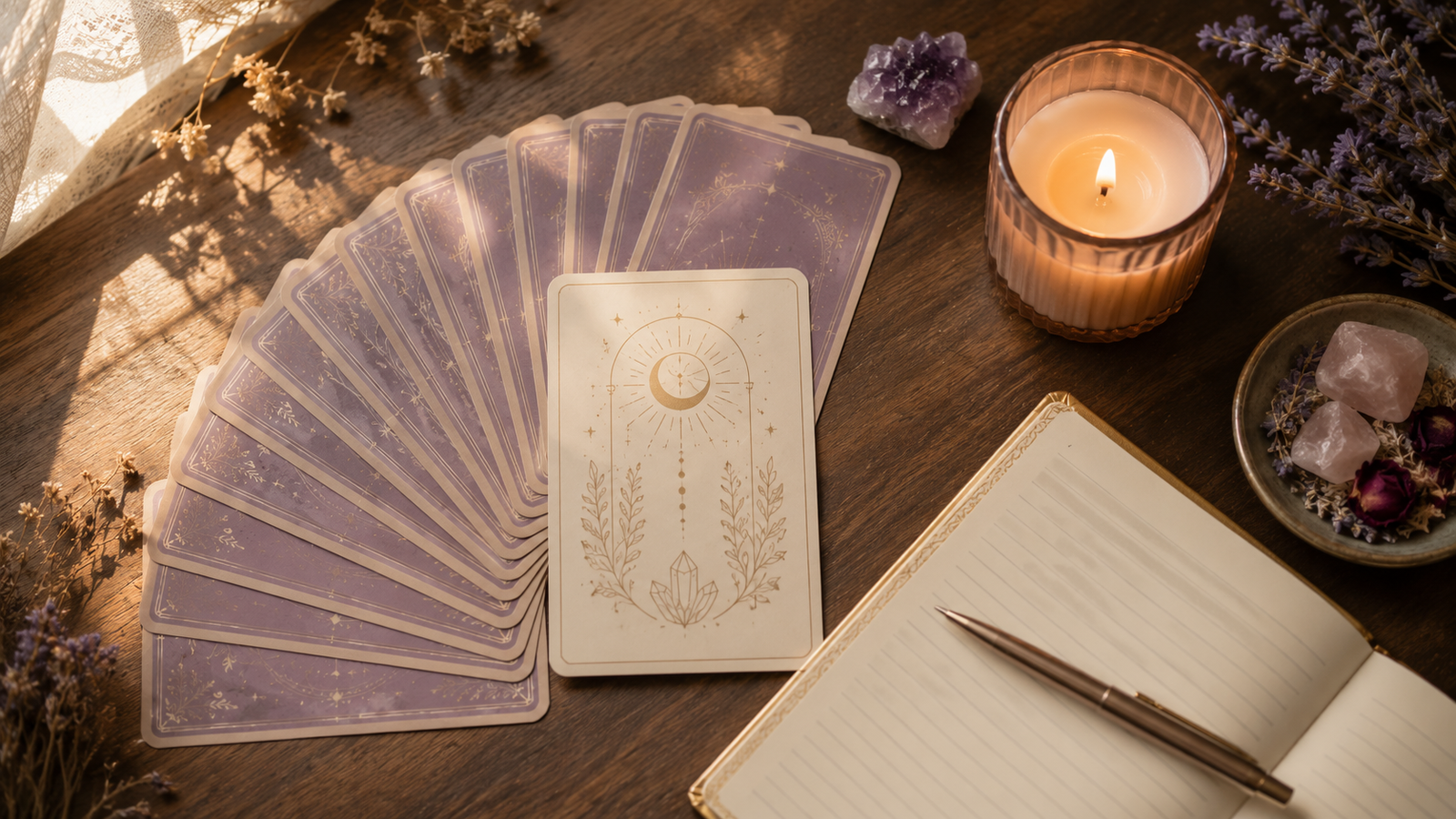
New to the cards? Here is a gentle, judgment-free introduction to the structure of the tarot deck and how to begin reading for yourself.
Welcome to the Garden of the Tarot
If you have felt drawn to tarot but were not sure where to begin, you are in exactly the right place. Tarot can look intimidating from the outside — seventy-eight cards, centuries of symbolism, an entire shelf of contradictory books — but at its heart it is something simple and human. Tarot is a mirror. It is a language of images that helps you slow down, ask better questions, and hear your own intuition more clearly. It does not predict a fixed, unchangeable future. Instead, it illuminates the present moment so you can move through it with more awareness.
Think of each card as a doorway into a conversation with yourself. The deck gives that conversation structure and vocabulary, but you are always the one doing the talking. This guide will walk you through the structure of the deck, your very first reading, how to handle reversed cards, a simple three-card spread to practice with, and how to build the kind of trust in yourself that turns a stack of cardboard into a lifelong companion.
Where Tarot Comes From
Tarot began in fifteenth-century Europe not as a mystical tool but as a card game. Decks like the Visconti-Sforza were painted for Italian nobility, and for centuries the cards were used much like an ordinary deck. It was only in the eighteenth and nineteenth centuries that occultists began to connect tarot to astrology, numerology, and esoteric philosophy. The deck most people picture today — the Rider-Waite-Smith deck, illustrated by Pamela Colman Smith and published in 1909 — made tarot accessible by giving every card a clear, scene-based image. You do not need to memorize this history to read well, but knowing that the cards are a living tradition, reshaped by each generation, can free you from the fear of "doing it wrong."
The Structure of the Deck
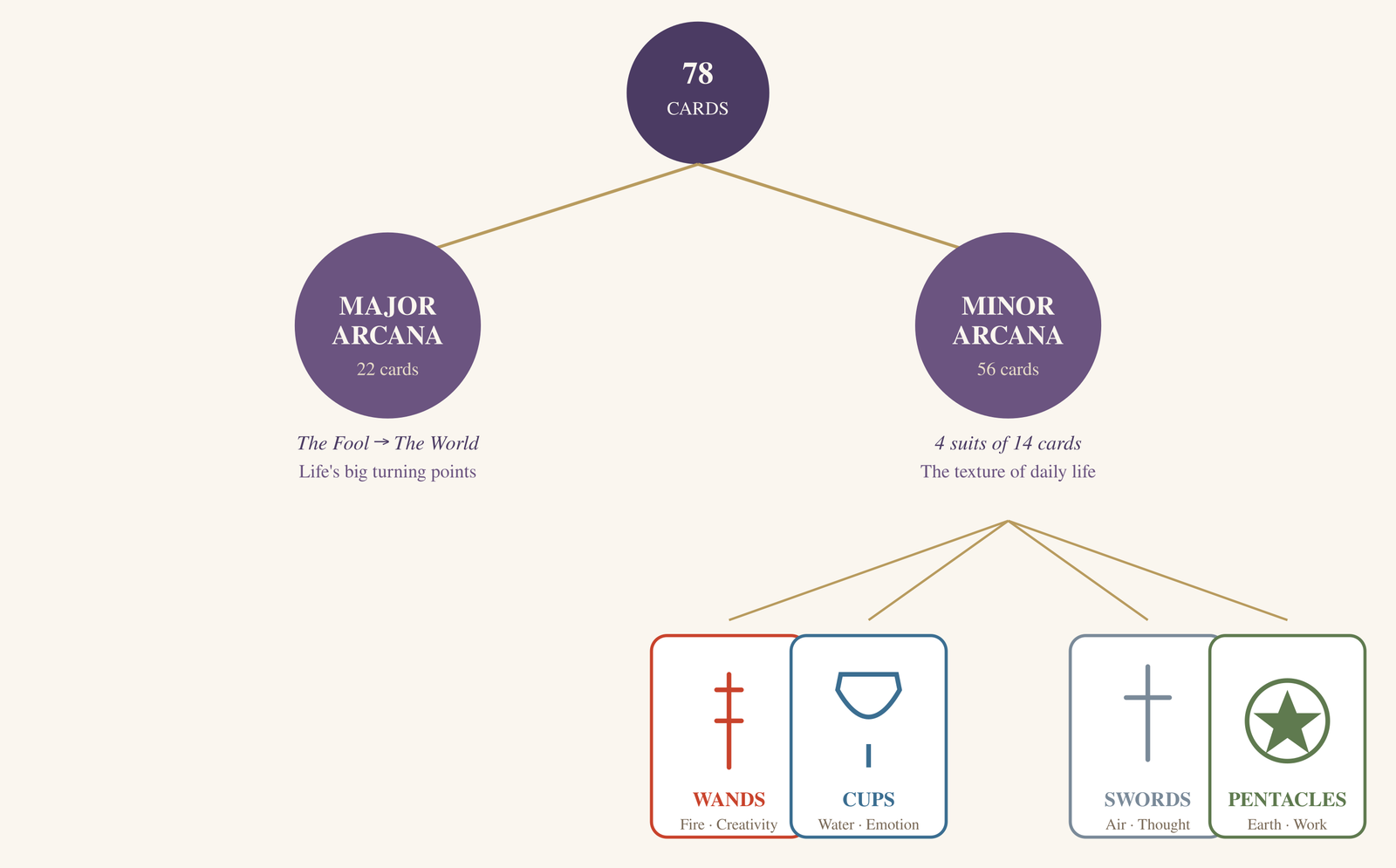
A standard tarot deck contains 78 cards, divided into two groups. The Major Arcana is a sequence of 22 cards, beginning with The Fool (numbered zero) and ending with The World. These cards speak to the big themes and turning points of a life — beginnings, love, ambition, transformation, surrender, completion. Many readers describe the Majors as "the Fool's journey," a story of a soul moving from innocent first steps to wholeness.
The Minor Arcana holds the remaining 56 cards, divided into four suits of 14 cards each. The Minors describe the texture of daily life. Each suit carries an elemental flavor:
- Wands carry the fire of creativity, passion, drive, and inspiration.
- Cups hold the water of emotion, love, intuition, and relationship.
- Swords cut through the air of thought, communication, conflict, and clarity.
- Pentacles ground us in the earth of work, money, health, and the material world.
Each suit runs from Ace through Ten, followed by four court cards: Page, Knight, Queen, and King. The courts can represent people in your life, aspects of yourself, or approaches you might take.
Your First Reading
Begin simply. There is no need for incense, candles, or a special table, though you are welcome to add them if they help you feel present. Shuffle the cards however feels natural while holding a question in your mind. The best beginner questions are open rather than yes-or-no. Instead of "Will I get the job?" try "What do I most need to understand about this opportunity?" Open questions invite the cards to offer insight rather than a verdict.
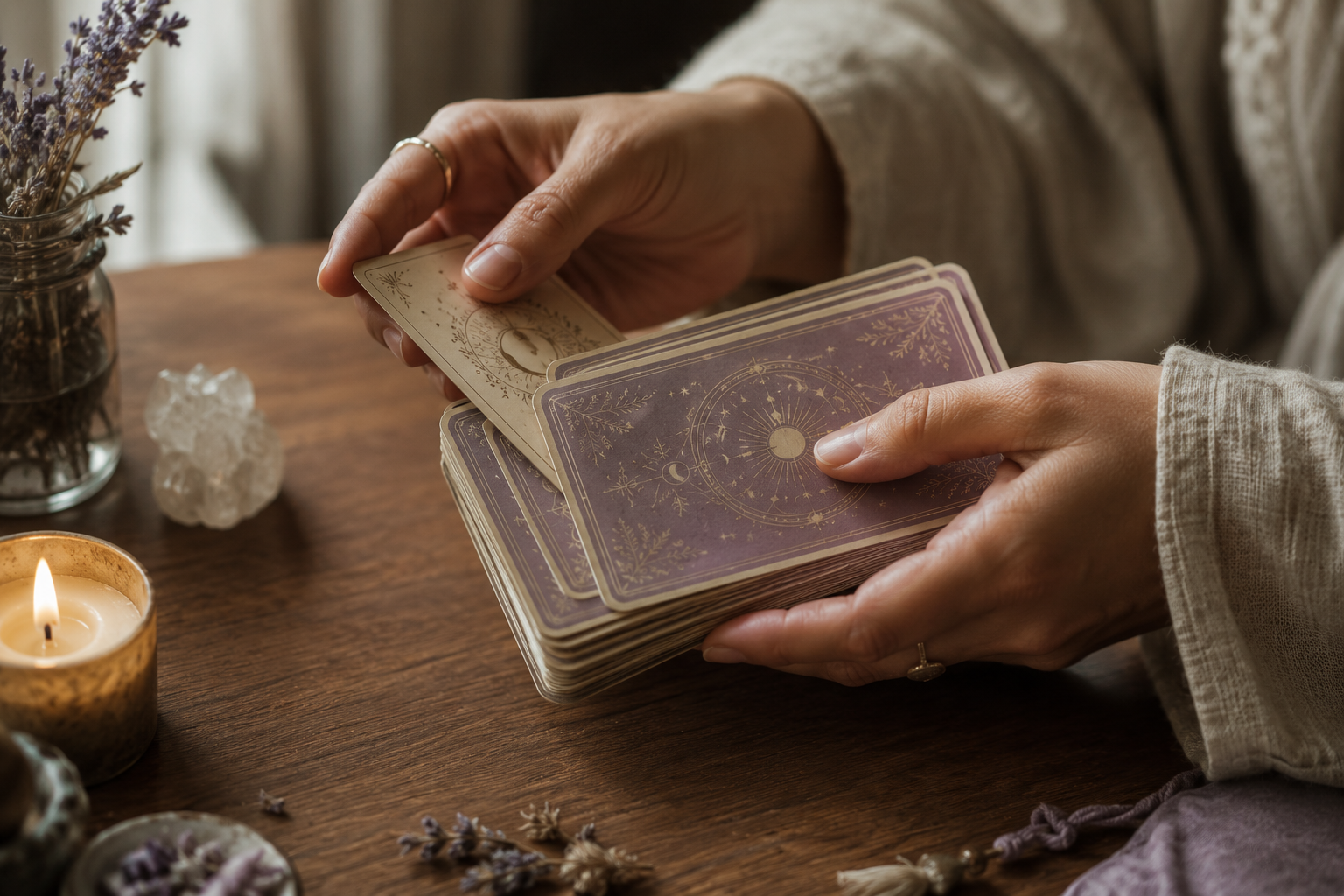
When the moment feels right, draw a single card. Before you reach for any book of meanings, simply look. What is happening in the image? How does the card make you feel? Your first impression is not a distraction from the reading; it is part of the reading. Only after you have sat with your own response should you consult the traditional meaning and let the two perspectives speak to each other.
A wonderful daily practice is the one-card pull. Each morning, draw a single card as a theme for the day. In the evening, return to it: did the card's energy show up? Over weeks, you will begin to recognize the cards as old friends.
If you would like a deck that feels comfortable in beginner hands, the Rider-Waite-Smith Tarot Deck on Amazon is the classic starting point — nearly every modern tarot book references its imagery directly. Pairing it with the Guided Tarot for Beginners companion book gives you a reference to return to as you build fluency with the cards. A soft velvet storage pouch keeps your deck protected between readings, and laying the cards on a dedicated tarot reading cloth helps define your space and signals to the mind that it is time to listen.
Reading Reversed Cards
When a card appears upside down, we call it reversed. Many newcomers worry that reversals are bad omens, but this is rarely the case. A reversed card usually points to energy that is blocked, delayed, turned inward, or expressed in excess. If reversals feel overwhelming at first, you have full permission to read every card upright while you learn.
A Simple Three-Card Spread
Once the single-card pull feels comfortable, the three-card spread is the natural next step. Shuffle while holding your question in mind, then lay three cards left to right and read them as a single unfolding sentence:
1. Past — what led to this moment
2. Present — the energy of right now
3. Future — where the current path tends
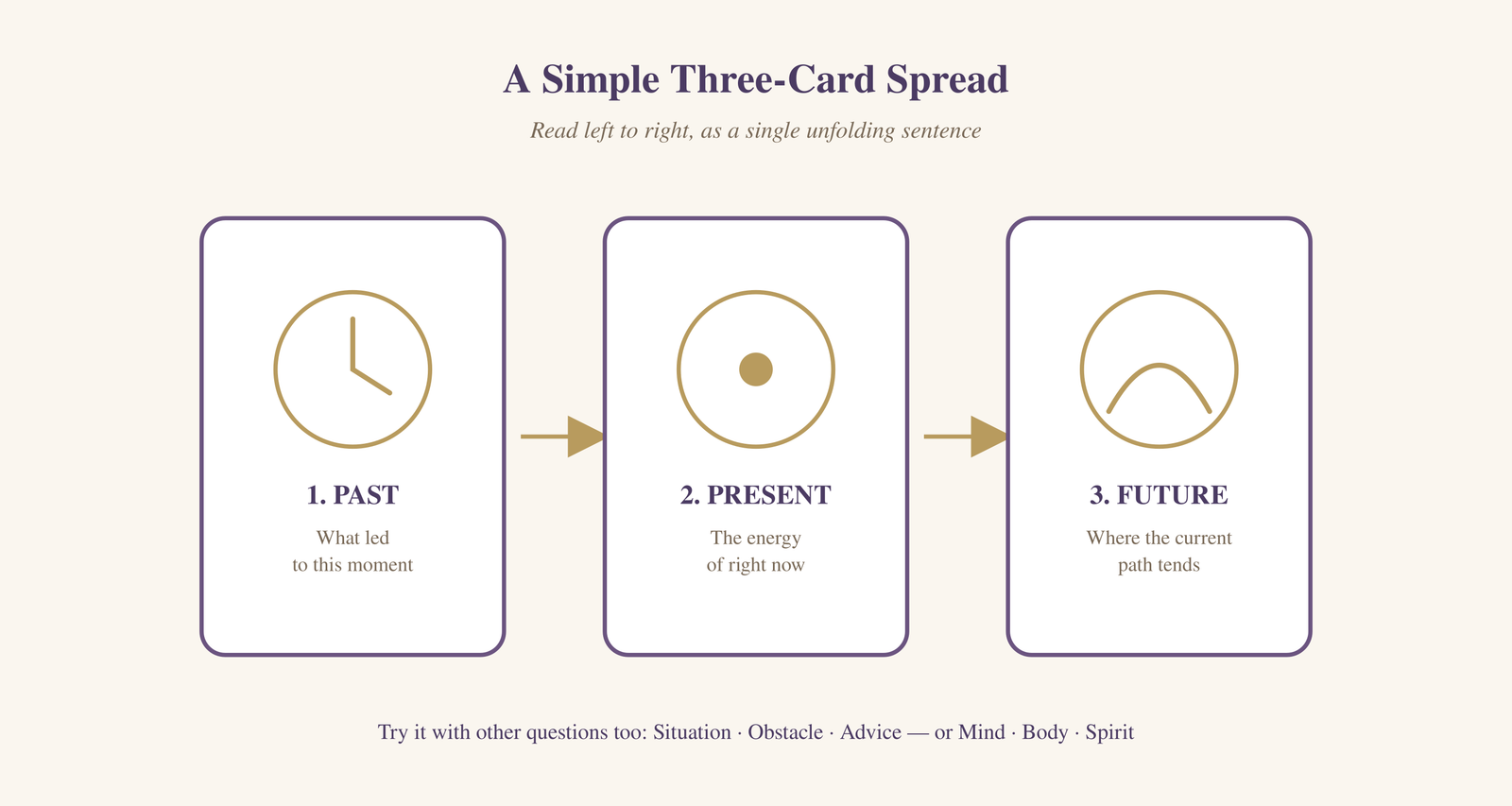
This same three-position structure works beautifully for other questions too — try Situation, Obstacle, Advice, or Mind, Body, Spirit when you want a different lens on the same simple shape.
Trusting Yourself
The most important tool in tarot is not the deck — it is your own intuition. The cards simply give it shape and language. Be patient and kind with yourself. Keep a small journal of your pulls and what unfolded; over time those notes become a record of your own growth and a personal dictionary of what each card means to you. A dedicated tarot journal with prompts and space for each pull makes the habit easy to keep and gives you a beautiful record to look back on as your practice deepens.
If you live in the Tampa Bay area, consider visiting one of the local metaphysical shops in our directory. In time, the garden of the tarot will feel less like a foreign country and more like home.
This post contains affiliate links. If you make a purchase through one of these links, Whispers & Wonders may earn a small commission at no additional cost to you. As always, we only recommend tools we genuinely believe support a beginner's practice.