Major Arcana · Card XIII
Home / Tarot Cards / Death
Death
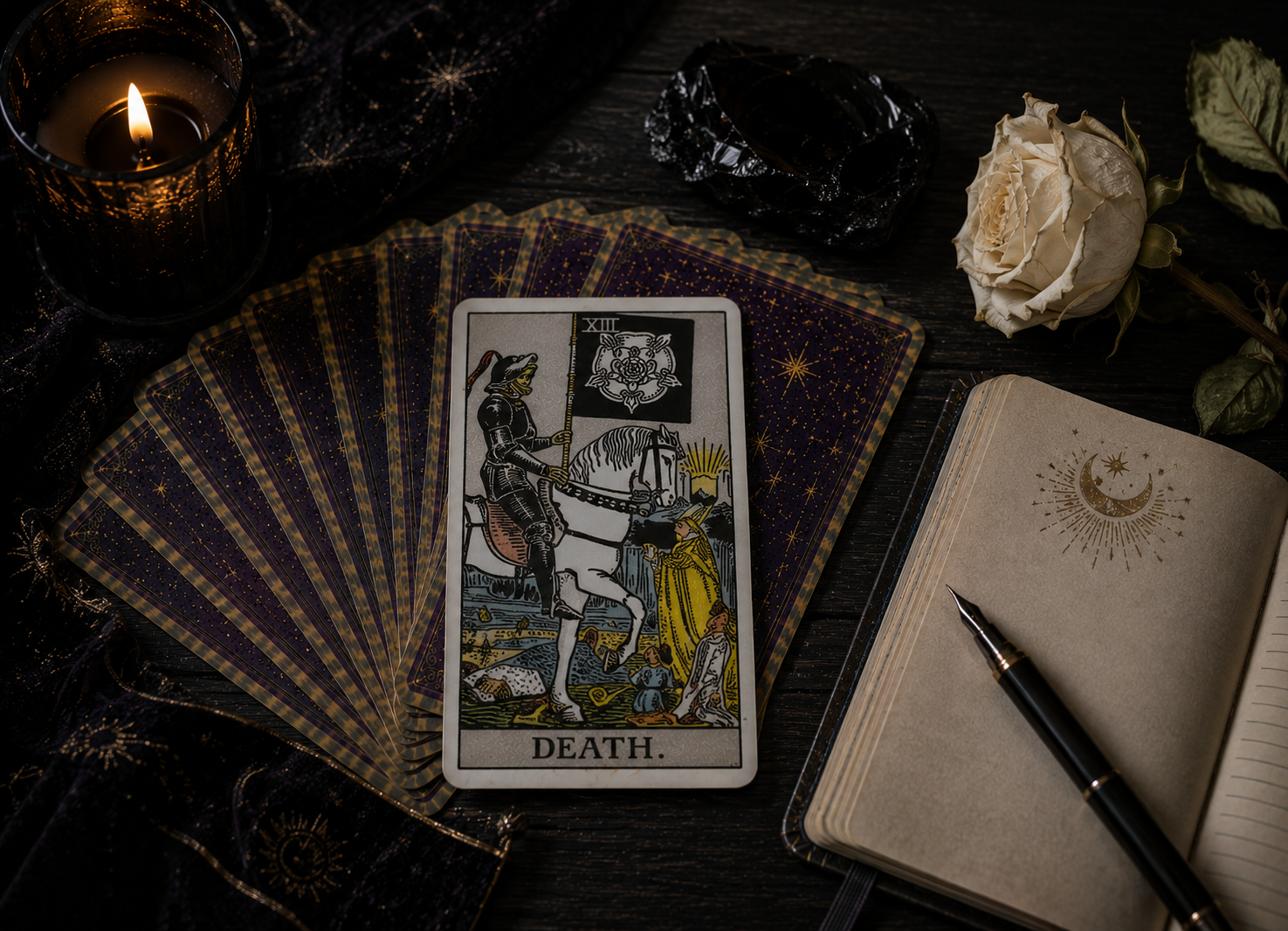
This is one of the most feared cards in the deck. It's also one of the most misunderstood.
Death almost never means what it sounds like. This card is about the endings that make room for what's next.
What Does Death Mean?
Death carries the number thirteen — a number historically associated with transformation, the end of one cycle and the beginning of another. In the tarot's story it arrives after The Hanged Man's willing surrender, and it completes what that surrender prepared: the actual ending. The actual letting go.
Experienced tarot readers are consistent about this card: its appearance in a reading rarely predicts physical death. What it does point to, with unusual clarity, is the ending of something significant — a phase, a relationship, a self-concept, a way of living — that needs to complete itself so that new life can arrive in its place.
The Story in the Image
In the 1909 Rider-Waite-Smith deck, a skeletal armored figure rides a white horse. He carries a black flag bearing a white rose — a pairing many readers interpret as death and renewal held together, the ending that carries within it the seed of what comes next. Whether the white rose on this card connects intentionally to the rose carried by The Fool is one interpretation among several; it's a popular reader observation, though not a documented design intent.
Before the horse stand four distinct figures, each responding to the approaching figure differently. A fallen king lies in the horse's path — even earthly authority cannot stop this ending. A bishop stands with hands raised in prayer, facing what comes. A maiden turns her face away, unable to look directly at the moment of transition. And a child reaches upward with flowers, seeing in the figure something the others cannot quite manage: the possibility of offering and receiving at the same time.
In the background, between two towers, the sun rises — not sets. This is crucial. Death arrives at sunrise, not sunset. The ending comes with the promise of a new day already beginning behind it.
Death Upright
Upright, Death is an invitation to release what has genuinely run its course. Not to destroy or force — but to honestly acknowledge the endings that are already happening and to stop spending energy trying to keep them from completing themselves.
This card often appears in readings when someone is holding on past the point where holding on serves them. Death's counsel is compassionate but clear: the white rose on that flag is real. The sunrise behind the towers is real. But they only become available once the ending is allowed to be an ending.
Death makes room. That's not cruelty — it's the most generous thing a card can offer.
Death Reversed
Reversed, Death often points to resistance to a necessary ending — the refusal to let something complete itself. The energy spent holding what has already ended in place is the same energy that would be available for what wants to begin.
It can also, less commonly, point to the opposite: a sudden ending that arrived without the inner preparation that would help it be processed — a loss that came too fast to absorb, an ending that hasn't been mourned yet and therefore hasn't quite released its hold.
Frequently Asked Questions
Does the Death card mean someone will die?
Experienced readers will tell you: this card rarely, if ever, predicts literal physical death. Its meaning is almost always metaphorical — the ending of a phase, relationship, belief, or identity that needs to complete itself so something new can begin.
Is Death a negative card?
Most readers see it as one of the most transformative and ultimately hopeful cards in the deck — precisely because it tells the truth about endings and points to what becomes possible when we stop resisting them. The sunrise in the background is not incidental.
What are the four figures in the Death card?
In the RWS deck, four figures face the approaching Death: a fallen king in the horse's path; a bishop standing in prayer with hands raised; a maiden turning her face away; and a child reaching upward with flowers. Many readers interpret them as four different ways of meeting necessary endings.
What does Death mean in a love reading?
Context matters enormously here. It can point to the end of a relationship, the end of a particular dynamic within one, or the necessary completion of an old pattern before something genuinely new can begin. It's rarely as stark as it initially appears.
Kenya Ferguson — Founder, The Sacred Heart Collective LLC
Kenya Ferguson is the founder of The Sacred Heart Collective and the creator of Whispers & Wonders. Tarot and crystals are personal practices for her — she shares what she has learned as a genuine enthusiast, not a certified reader or healer. Her approach favors curiosity and honesty over authority.