Major Arcana · Card XV
Home / Tarot Cards / The Devil
The Devil
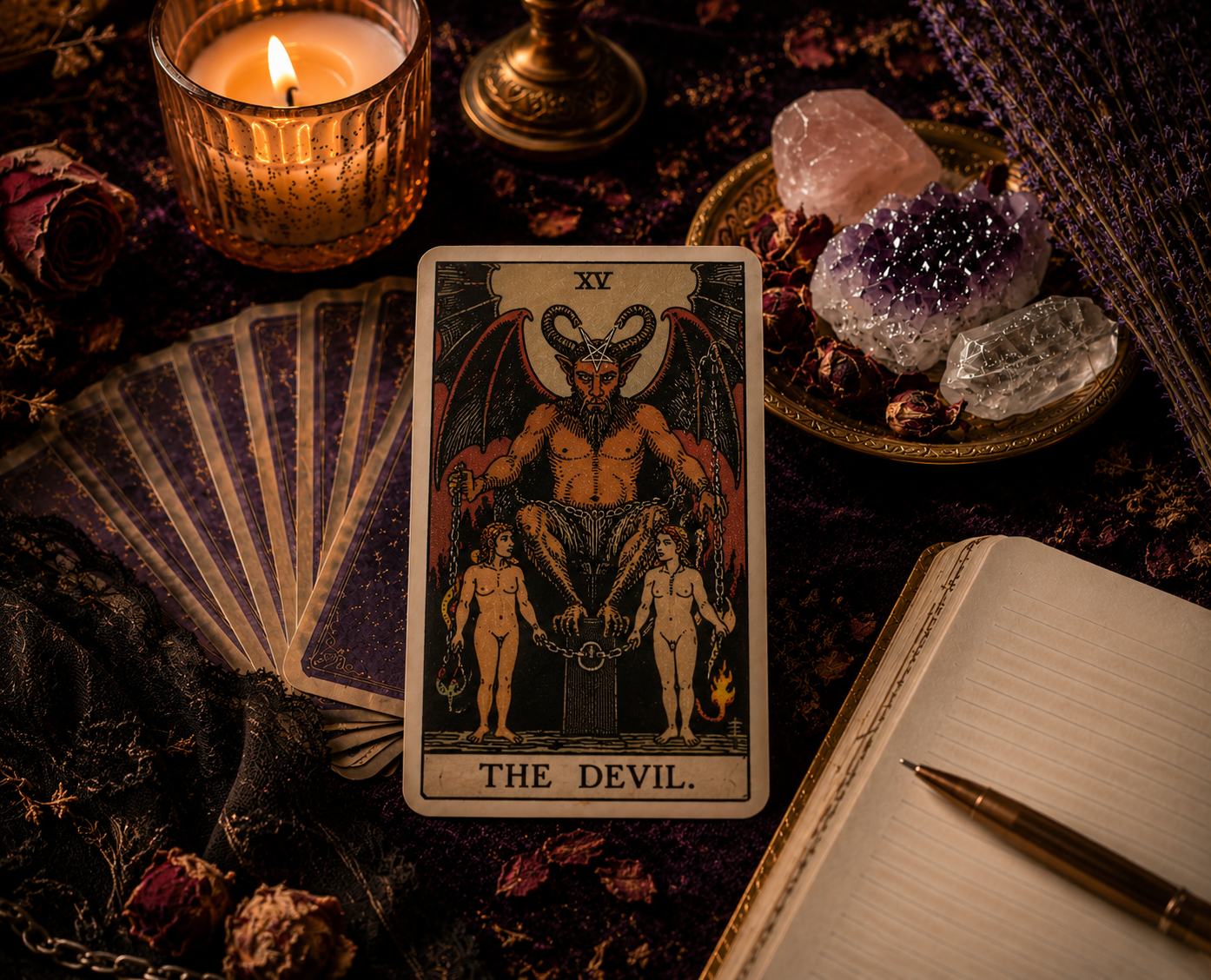
After Temperance's patient blending, the tarot turns to confront what balance sometimes hides: the chains we've mistaken for permanent, the patterns we've stopped questioning.
The Devil confronts the chains we've mistaken for permanent — and shows they were never locked.
What Does The Devil Mean?
The Devil carries the number fifteen — arriving directly after Temperance's careful integration and just before The Tower's sudden collapse. In the tarot's story, it marks the moment the work of balance meets its shadow: the point where old patterns, dependencies, and self-imposed limitations are named for what they are.
The card is often misread as a warning about evil or sin. Its older, more useful meaning is closer to bondage — specifically, the kind of bondage that convinces us we have no choice. Addiction, unhealthy attachment, fear disguised as practicality, the comfortable trap of "this is just how it is." The Devil doesn't create these chains. It reveals them.
The Story in the Image
In the 1909 Rider-Waite-Smith deck, a horned, winged figure — part goat, part bat, part man — sits on a black cube pedestal. This figure is often identified with Baphomet, though that identification comes from later tradition rather than the deck's original documentation. An inverted pentagram is set into the figure's forehead, and its right hand is raised in a gesture that mirrors — and inverts — the Hierophant's blessing earlier in the deck.
Below, a naked man and woman stand chained by the neck to the same pedestal. Small tails are visible on each of them — a hint that prolonged captivity has begun to reshape them in the Devil's image. This detail is present in the actual RWS artwork and is one of the card's most quietly unsettling touches.
The detail many readers miss entirely: the chains around their necks are loose. Loose enough to lift off without much effort. Nothing in the image shows the chains locked or fastened tight — the captivity is real, but it is not, strictly speaking, inescapable. This is the card's central teaching, and it's easy to walk past it the first dozen times you look at the image.
The Devil Upright
Upright, The Devil is an invitation to look honestly at where you've stopped questioning a limitation. It often shows up around addiction, codependency, financial entanglement, or any relationship — to a person, a substance, a job, a belief about yourself — that has quietly become the thing running the show.
It isn't only about dramatic bondage. Often it's smaller and stranger than that: the version of yourself you perform because it's easier than the alternative, the comfort that has become a cage, the "no choice" that is, on closer inspection, a choice you stopped noticing you were making.
The chains were never locked. They only ever needed to be seen.
The Devil Reversed
Reversed, The Devil often signals the beginning of release — the moment awareness turns into action, and a pattern that felt permanent starts to loosen its grip. This can look like breaking an unhealthy habit, ending a relationship built on dependency rather than choice, or simply naming a fear out loud for the first time.
It can also point to a more difficult reading: a pattern that's been broken once but is creeping back, or a person who sees the chain clearly and still isn't ready to lift it off. The Devil reversed doesn't promise the work is finished. It asks whether you're actually ready to do it.
Frequently Asked Questions
Is The Devil a bad card?
Not inherently. The Devil rarely predicts misfortune — it points to a pattern, attachment, or limitation worth examining honestly. Its message is confronting, not doom-laden, and many readers find it one of the more useful cards to draw because it asks a direct question rather than delivering a vague warning.
What does The Devil mean after Temperance?
Following Temperance's careful balancing, The Devil represents the shadow side that balance can sometimes obscure — the patterns, dependencies, or fears that have gone unexamined even while other areas of life feel steady. It's an invitation to look at what the calm might be quietly accommodating.
Does The Devil mean addiction?
It can, though its meaning is broader than substance addiction alone. The Devil speaks to any dependency or pattern that has come to feel involuntary — a relationship, a habit, a belief, a coping mechanism — regardless of whether it involves a substance.
Why are the chains loose in The Devil card?
The loosely draped chains are a deliberate detail in the original Rider-Waite-Smith artwork. Many readers interpret this as the card's central message: the bondage shown is not absolute. It suggests that freedom, while not always easy, is usually more available than it feels from inside the pattern.
Kenya Ferguson — Founder, The Sacred Heart Collective LLC
Kenya Ferguson is the founder of The Sacred Heart Collective and the creator of Whispers & Wonders. Tarot and crystals are personal practices for her — she shares what she has learned as a genuine enthusiast, not a certified reader or healer. Her approach favors curiosity and honesty over authority.