Major Arcana · Card IV
Home / Tarot Cards / The Emperor
The Emperor
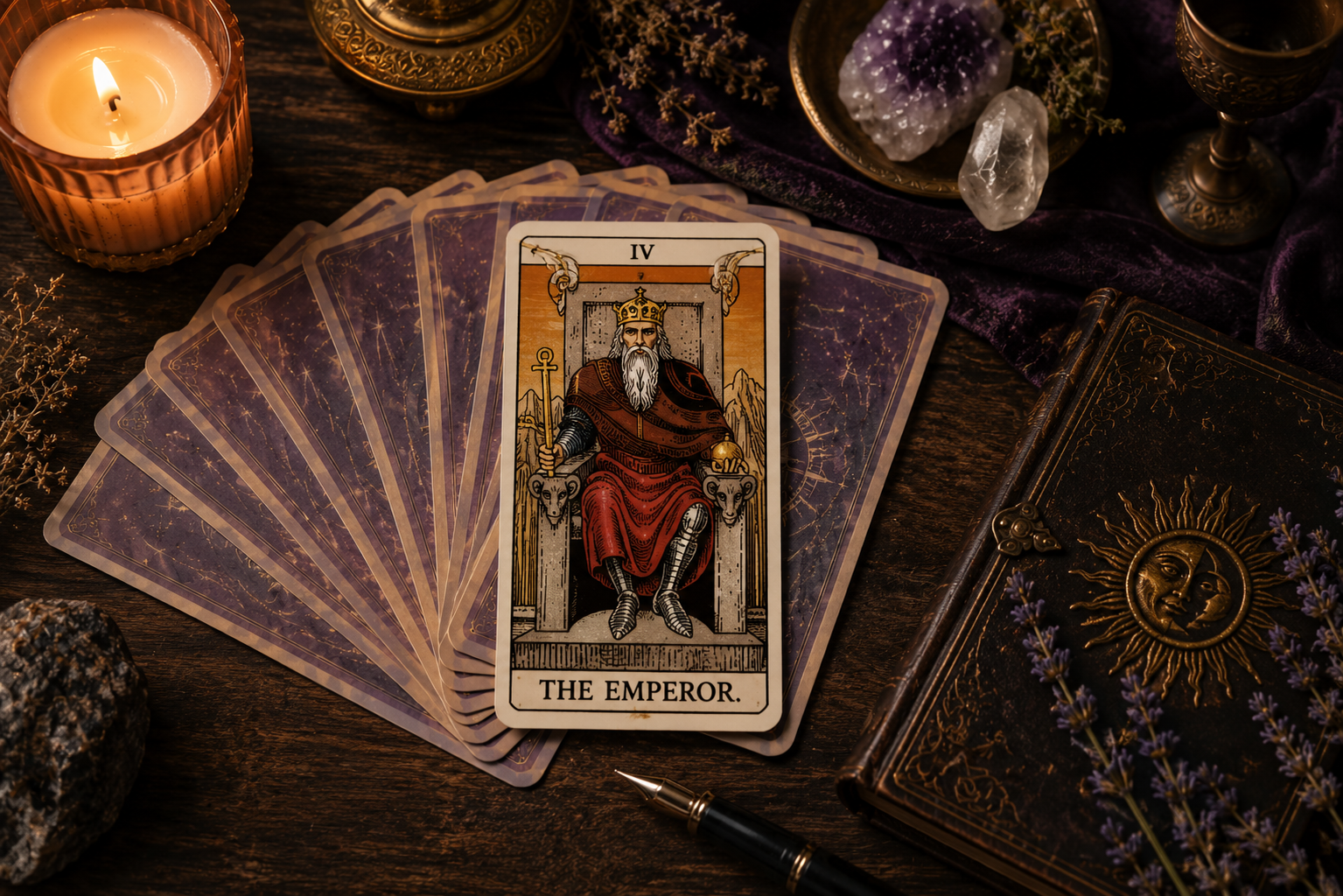
Every garden needs a wall. Not to keep the world out, but to give what's growing inside it a chance to take root. Structure isn't the enemy of growth — sometimes it's the only thing that makes growth possible.
The tarot has a card for that steady, foundational energy. It's called The Emperor, and it asks where your life could use a little more structure — and what that structure would protect.
What Does The Emperor Mean?
The Emperor is the card of structure, stability, and protective authority. He carries the number four — and four is the tarot's most solid number. Four corners. Four walls. Four seasons. Four is the shape of things built to last.
His place in the story matters, too. The Fool leapt, The Magician focused, The High Priestess listened, and The Empress grew a garden. The Emperor arrives to do what none of them could: make it permanent. He builds the walls that let the garden survive winter. When he appears in a reading, he often asks a builder's question: what in your life needs a stronger foundation?
The Story in the Image
The Emperor has ruled beside The Empress since tarot's earliest Italian decks in the fifteenth century, when emperors and popes were the very picture of earthly power. In the 1909 Rider-Waite-Smith deck, Pamela Colman Smith set him high in a range of bare mountains — a deliberate contrast to The Empress's lush river valley.
Interpretations vary between traditions, but here's what readers commonly see. His throne is carved stone, decorated with rams' heads — the mark of Aries, the zodiac's bold first sign, linking him to courage and initiative. In one hand he holds an ankh, the ancient Egyptian symbol of life; in the other, a golden orb representing the world in his care. His robes are red — vitality and command — but beneath them glints armor. That detail is the key to the whole card: he is dressed not to conquer, but to defend. Even the barren mountains speak: his gift isn't growth. It's the unmoving ground that growth depends on.
The Emperor Upright
Upright, The Emperor is an invitation to build. Create the routine that carries your goal on the days motivation doesn't. Set the boundary that protects your peace. Bring order to the corner of your life that's been running on improvisation.
His deeper teaching is about self-authority: becoming the kind of leader for your own life that you'd willingly follow. Keeping promises to yourself. Being consistent when consistency is boring. The Emperor knows a secret our culture often forgets — discipline isn't the opposite of freedom. It's the ground freedom stands on.
Discipline isn't the opposite of freedom. It's the ground freedom stands on.
The Emperor Reversed
Turned upside down, The Emperor tends to ask questions in two directions. The first: has structure hardened into rigidity? Rules that once served you can calcify into rules for their own sake. Control, gripped too tightly, suffocates the very things it means to protect.
The second points the opposite way: is there too little structure? Dreams without foundations stay dreams. Boundaries never set become resentments quietly collected.
Neither reading is an accusation. The reversed Emperor is simply a surveyor's report — an honest look at your foundations, and an invitation to rebuild: firm where it matters, flexible where it doesn't.
Frequently Asked Questions
Is The Emperor a positive card?
Most readers see him as steadying and encouraging — a sign of stability, capability, and protection. As always, context shapes his message, but his core energy is that of a guardian, not a tyrant.
What's the relationship between The Empress and The Emperor?
They're the tarot's great pair: nurture and structure, garden and wall, growth and ground. Neither is complete alone — the garden needs protection, and the walls need something worth protecting.
Does The Emperor represent a specific person in my life?
Some readers interpret court-like cards as people in certain contexts, but he's most useful as a mirror: the steady, protective authority you can build within yourself.
What does The Emperor mean in a yes/no reading?
Many practitioners read him as "yes — if it's built on a solid foundation." Approaches to yes/no readings vary widely between readers.
Kenya Ferguson — Founder, The Sacred Heart Collective LLC
Kenya Ferguson is the founder of The Sacred Heart Collective and the creator of Whispers & Wonders. Tarot and crystals are personal practices for her — she shares what she has learned as a genuine enthusiast, not a certified reader or healer. Her approach favors curiosity and honesty over authority.