Major Arcana · Card XII
Home / Tarot Cards / The Hanged Man
The Hanged Man
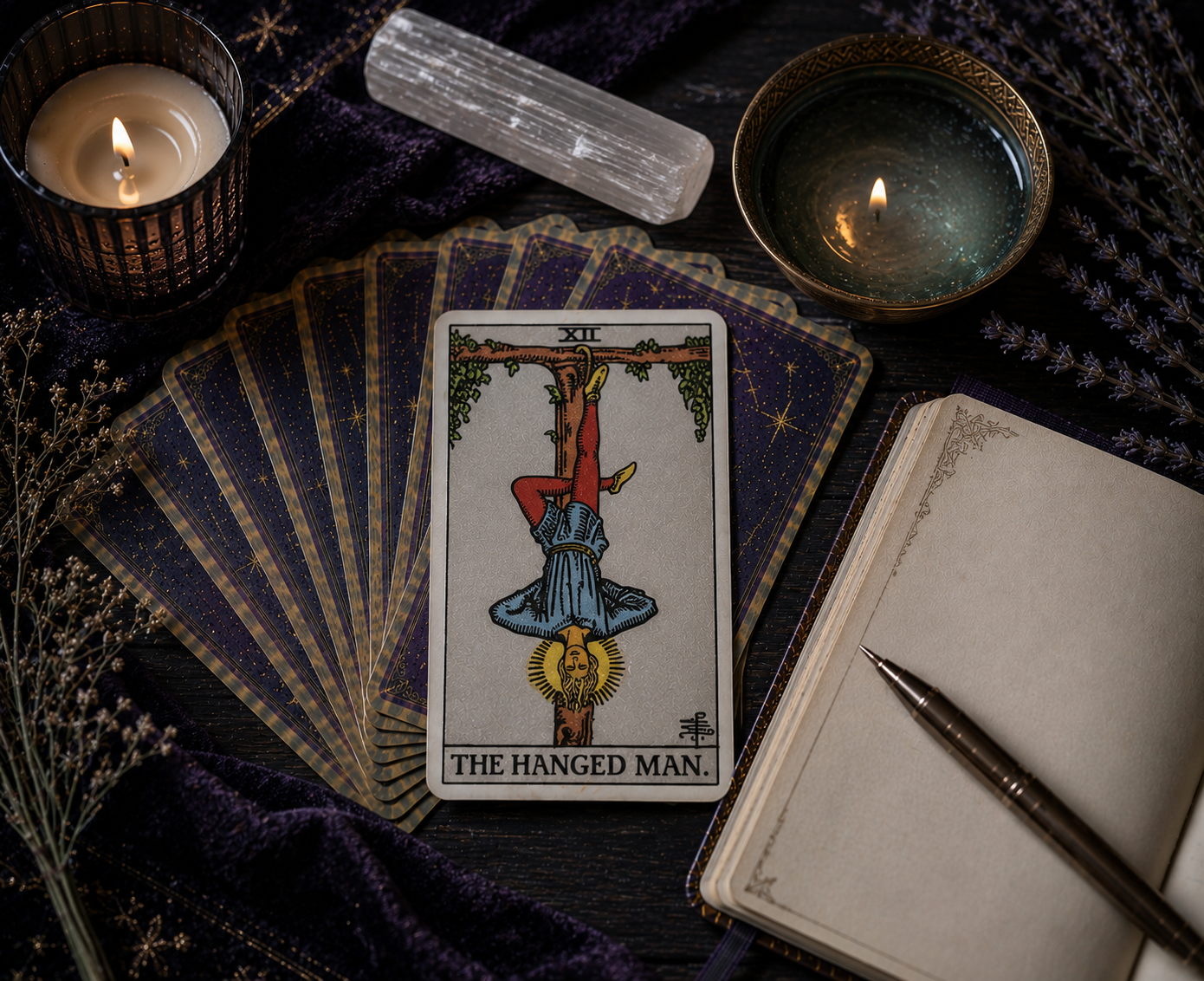
There is something uncomfortable about this card. That's by design.
The Hanged Man is a pause that asks for a completely different point of view — and pauses like that are rarely comfortable until you stop fighting them.
What Does The Hanged Man Mean?
The Hanged Man carries the number twelve — a number of cycles, completion, and the threshold before a major transformation. He arrives in the tarot's story between Justice's honest assessment and Death's necessary ending, and he inhabits the pause between them with unusual grace.
This card is one of the most misread in the tarot. The name and the imagery suggest crisis or punishment. But the figure's expression tells a different story entirely: he is serene. He chose this position. The Hanged Man isn't about being stuck against your will — it's about the willingness to surrender control long enough for a completely different perspective to arise.
The Story in the Image
In the 1909 Rider-Waite-Smith deck, a man hangs upside down from one foot, suspended from a living wooden gibbet. That detail matters: the gibbet isn't a dead beam of execution but a living, leaf-budding T-shaped cross — a Tau cross, with branches that continue to grow even as it serves as a threshold. Life continues even in suspension.
The man's free leg is bent at the knee behind the other, forming a figure four — a posture that requires a kind of active, practiced balance rather than simple hanging. He is not collapsed. He is poised. Around his head glows a halo of golden light: illumination, not suffering.
Some readers connect this image to the Norse god Odin, who hung himself from the World Tree Yggdrasil to receive the wisdom of the runes. This is a popular interpretation among many readers, but it's worth noting that this mythological connection is a reader tradition rather than a documented intent of the deck's creators — it remains a meaningful lens for some, and an optional one.
The Hanged Man Upright
Upright, The Hanged Man is an invitation to stop — not out of defeat, but out of wisdom. The view from the right-side-up perspective has stopped yielding answers. The invitation is to try the view from upside down.
This might mean a deliberate pause before making a decision, a period of voluntary waiting while a situation develops, or the willingness to release a plan that isn't working in exchange for something you can't yet see but can feel arriving.
The Hanged Man isn't stuck. He's suspended by choice — and the halo says it's working.
The Hanged Man Reversed
Reversed, The Hanged Man often points to resistance to the necessary pause — forcing action when suspension is what the moment calls for, insisting on pushing through when stepping back would serve better.
It can also point to a pause that has gone on too long. Suspension that was once wisdom has calcified into avoidance. The tree is still growing, the halo still glowing — but the time to return to movement has arrived, and you're still hanging.
Frequently Asked Questions
Is The Hanged Man a bad card?
No — though it's frequently misread that way. The figure's serene expression and halo of light indicate that this is a chosen, illuminated pause, not a punishment. Most readers see it as a card of necessary surrender and perspective shift.
What does The Hanged Man mean in a love reading?
Many readers connect it to a period of patient waiting, a need to see a relationship from a different angle, or the release of a fixed narrative about a person or connection. Context shapes its specific message.
Why is the gibbet in The Hanged Man a living tree?
The T-shaped (Tau) cross from which the man hangs is depicted as a living, leaf-budding structure in the RWS deck. Many readers interpret this as a sign that life and growth continue even in the period of suspension — the pause is fertile, not dead.
Is The Hanged Man connected to the Norse god Odin?
This is a popular interpretation — Odin hung from the World Tree Yggdrasil for nine days to gain the wisdom of the runes. Many readers find this connection meaningful. However, it's a reader tradition rather than a documented intent of the deck's original creators, so it's best understood as an interpretive lens, not a definitive origin.
Kenya Ferguson — Founder, The Sacred Heart Collective LLC
Kenya Ferguson is the founder of The Sacred Heart Collective and the creator of Whispers & Wonders. Tarot and crystals are personal practices for her — she shares what she has learned as a genuine enthusiast, not a certified reader or healer. Her approach favors curiosity and honesty over authority.