Major Arcana · Card V
Home / Tarot Cards / The Hierophant
The Hierophant
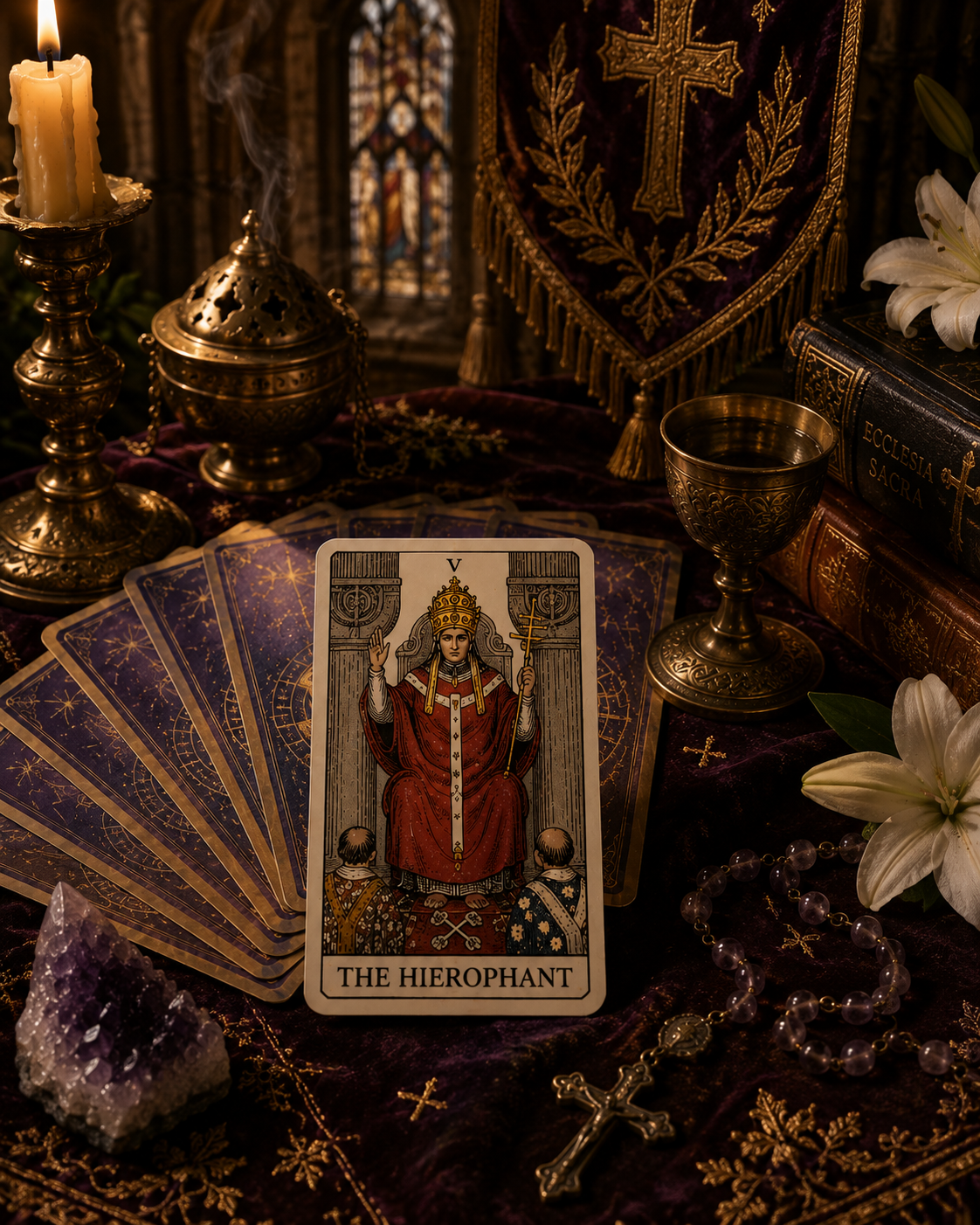
Some wisdom can't be figured out alone. It arrives through hands that have done the work longer than yours — a teacher, a tradition, a lineage of practice that was already old before you were born. There's a humility in letting yourself be taught.
The tarot has a card for that exchange. It's called The Hierophant, and it asks what you might learn by standing inside a tradition instead of always outside it.
What Does The Hierophant Mean?
The Hierophant is the card of tradition, teaching, and shared wisdom. He carries the number five — and after the solid square of The Emperor's four, five is a number that stirs. It's the number of the seeker and the teacher, of questions and the guidance that answers them.
In the tarot's story, his role is clear. The High Priestess held wisdom that was silent, inward, and personal. The Hierophant holds wisdom that is spoken, shared, and communal. He's the mentor, the tradition, the institution, the belief system — everything that lets us learn from those who walked the path before us instead of starting from nothing. When he appears in a reading, he often points to learning, guidance, or belonging.
The Story in the Image
The Hierophant's name comes from ancient Greece, where a hierophantēs was a priest who revealed sacred mysteries. In early tarot decks he was called The Pope, a mirror to The High Priestess's Papess — the public, outer face of spiritual authority beside her hidden, inner one.
In the 1909 Rider-Waite-Smith deck, Pamela Colman Smith painted him rich with meaning. Interpretations vary between traditions, but here's what readers commonly see. He sits between two stone pillars — an echo of The High Priestess, but where hers framed a veil, his frame an open teaching. One hand is raised in blessing; the other holds a staff of office. Two students kneel before him, receiving what he passes down. And at his feet lie two crossed keys — often read as the keys to sacred knowledge, and the truth that understanding can unlock doors. His triple crown and layered robes speak of structure, hierarchy, and the long institutions that carry wisdom across generations.
The Hierophant Upright
Upright, The Hierophant is an invitation to learn from something proven. Seek the teacher. Join the class. Study the tradition with roots. He appears when there's real value in the established path — when the humility to be a student opens more doors than the pride of going it alone.
There's quiet wisdom in this. Not every question needs a brand-new answer. Some of life's deepest knowledge has already been discovered, refined, and preserved by generations of seekers. The Hierophant invites you to receive that inheritance — to let yourself be taught by what has already stood the test of time.
Not every question needs a brand-new answer. Some of life's deepest knowledge has already been discovered, refined, and preserved by generations of seekers.
The Hierophant Reversed
Turned upside down, The Hierophant asks braver questions. Are you following a rule you've never truly examined? Does a belief you inherited still fit the person you've become — or are you keeping it only because setting it down feels disloyal?
The reversed Hierophant often marks a meaningful threshold: the moment a seeker steps beyond inherited answers to find their own truth. This isn't rebellion for its own sake, and it rarely means throwing everything away. More often it's a careful sorting — keeping what still rings true, and gently releasing what doesn't. It's the sacred, personal work of deciding what you actually believe.
Frequently Asked Questions
Is The Hierophant a positive card?
Most readers see him as steady and supportive — a card of guidance, learning, and belonging. As always, context shapes his message, but his core energy is that of a wise and generous teacher.
Why is The Hierophant sometimes seen as a "difficult" card?
Because he represents tradition and convention, some readers associate him with conformity or rigidity. But at his heart he's about meaningful guidance and shared wisdom — the difference lies in whether tradition is examined and chosen, or simply obeyed.
What's the difference between The High Priestess and The Hierophant?
They're two faces of spiritual wisdom. The High Priestess is inner, silent, and intuitive — wisdom you discover alone. The Hierophant is outer, spoken, and communal — wisdom you're taught and share.
What does The Hierophant mean in a yes/no reading?
Many practitioners read him as a "yes," especially through traditional or established routes. Approaches to yes/no readings vary widely between readers.
Kenya Ferguson — Founder, The Sacred Heart Collective LLC
Kenya Ferguson is the founder of The Sacred Heart Collective and the creator of Whispers & Wonders. Tarot and crystals are personal practices for her — she shares what she has learned as a genuine enthusiast, not a certified reader or healer. Her approach favors curiosity and honesty over authority.