Major Arcana · Card II
Home / Tarot Cards / The High Priestess
The High Priestess
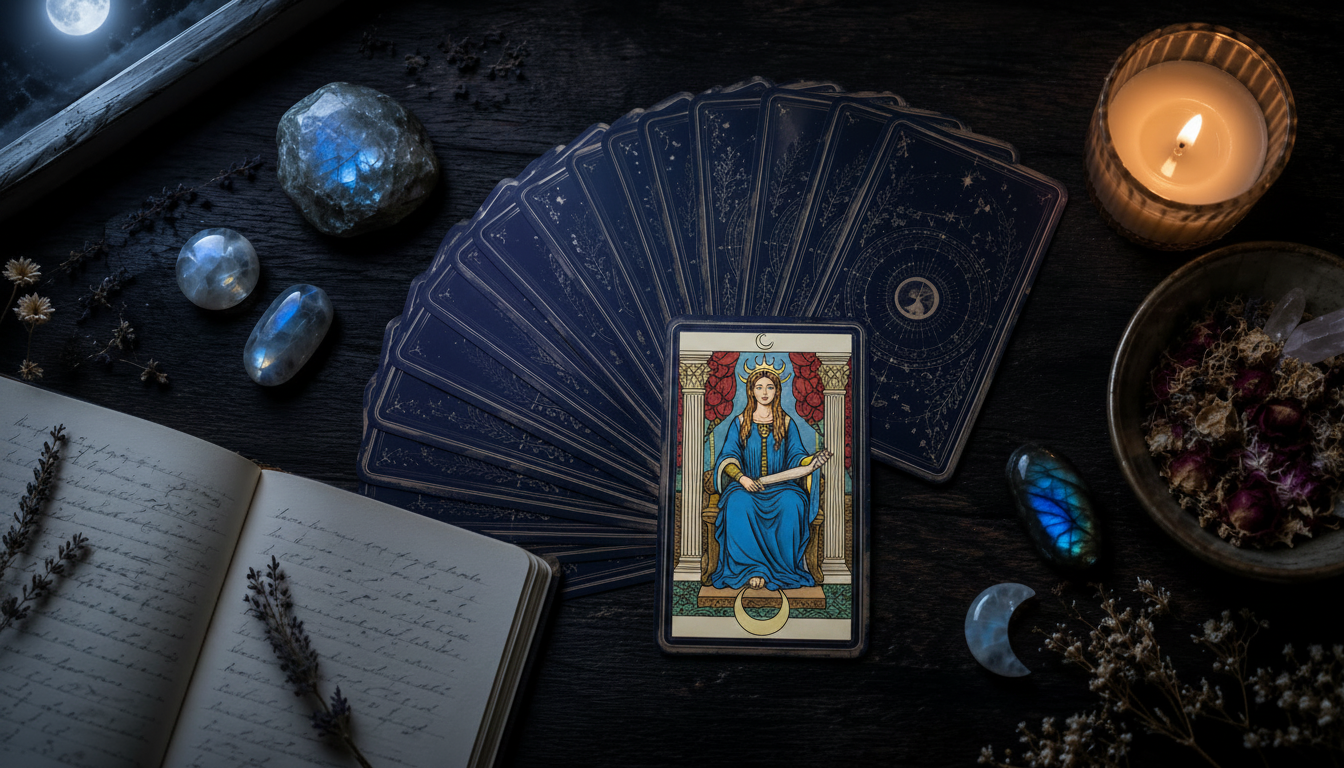
There's a kind of knowing that doesn't arrive in words. It comes as a quiet pull, a hunch, a sense that something is true before you can explain why. Most of us learn to talk over it — and most of us regret it later.
The tarot has a card that asks us to stop and listen. It's called The High Priestess, and she stands at the threshold between what we can see and what we can only feel.
What Does The High Priestess Mean?
The High Priestess is the card of intuition and inner knowing. She carries the number two — the number of balance, duality, and the space between opposites. And her place in the tarot's story matters deeply.
The journey began with The Fool, who leapt into the unknown. Then came The Magician, who gathered his tools and acted. The High Priestess is the deliberate pause that follows. She teaches the lesson action cannot: that some answers are not found. They surface — but only in stillness.
When she appears in a reading, she often suggests that the guidance you're searching for isn't out in the world. It's already within you, waiting beneath the noise.
The Story in the Image
The High Priestess has deep roots. In early Italian decks she was called *La Papessa* — the Papess, or female pope — a mysterious and even daring figure for her time. Some historians connect her imagery to the medieval legend of Pope Joan; others to a 13th-century Italian nun, Sister Manfreda, associated with the Visconti family who commissioned early decks. Her exact origins remain uncertain — fittingly, for the tarot's great keeper of mysteries.
In the 1909 Rider-Waite-Smith deck, Pamela Colman Smith gave her the form we know today, rich with symbols. Interpretations vary between traditions, but here is what readers commonly see. She sits between two pillars, one black and one white — often read as the great opposites: light and shadow, known and unknown. She favors neither. Behind her hangs a veil embroidered with pomegranates, widely understood as the boundary of the subconscious — the threshold between what we know and what we only sense. A crescent moon rests at her feet, tying her to cycles, tides, and dreams. And in her arms she holds a scroll marked "Tora," often read as sacred law or hidden knowledge — kept partly covered, because some wisdom cannot be handed over. It must be discovered.
The High Priestess Upright
Upright, The High Priestess is an invitation to trust yourself — specifically, the quiet part of yourself that notices everything. Intuition isn't mystical guesswork. It's the sum of everything you've ever observed, felt, and learned, speaking in a voice softer than thought.
This card often appears when you've been gathering opinions, making pro-and-con lists, and asking everyone but yourself. Her counsel is gentle and firm: *be still. You already know.*
The High Priestess Reversed
Turned upside down, she tends to ask two very different questions. The first: have you been silencing your inner voice because what it says is inconvenient? The truth that keeps rising — about a job, a habit, a relationship — doesn't disappear when ignored. It just waits.
The second question points the other way: have you withdrawn too far inward? Reflection is nourishing; endless rumination is not. A reversed High Priestess sometimes signals that it's time to bring your inner knowing back out into the daylight and live by it.
Neither reading is a judgment. Both are invitations back to balance.
Frequently Asked Questions
Is The High Priestess a positive card?
Most readers receive her warmly. She's less about "good news" and more about deep guidance — a reminder that your inner compass is working, if you'll consult it.
What's the difference between The Magician and The High Priestess?
They're two halves of wisdom. The Magician is outward: action, will, and skill. The High Priestess is inward: intuition, stillness, and knowing. The tarot places them side by side because neither is complete alone.
What does The High Priestess mean in a yes/no reading?
Many practitioners read her not as yes or no, but as "the answer is within you — be still and listen." Approaches to yes/no readings vary widely.
Does The High Priestess mean secrets are being kept from me?
Sometimes readers interpret her that way in context, but more often she points to what you sense and haven't yet acknowledged. Tarot works best as a mirror for your own awareness, not a surveillance tool.
Kenya Ferguson — Founder, The Sacred Heart Collective LLC
Kenya Ferguson is the founder of The Sacred Heart Collective and the creator of Whispers & Wonders. Tarot and crystals are personal practices for her — she shares what she has learned as a genuine enthusiast, not a certified reader or healer. Her approach favors curiosity and honesty over authority.