The Journal
Home / Blog / Building a Daily Tarot Ritual That Lasts
Building a Daily Tarot Ritual That Lasts

Consistency, not complexity, is the heart of a meaningful tarot practice. Here is how to build a daily ritual you will actually keep — no candles, incense, or perfect mornings required.
A Guide From Someone Still Finding Her Way Back
I'll be honest: I don't have a daily tarot practice, not really. I mean to pull a card most mornings, and some weeks I do — then life gets busy, the deck sits untouched for a stretch, and I tell myself I'll start again tomorrow. What's kept me connected in the gaps is watching Minot Pond Tarot on YouTube pretty regularly. Even on the mornings I don't draw my own card, watching someone else's reading keeps the practice close enough that coming back never feels like starting from zero.
Writing this guide is part of how I'm working my way back into my own daily pull. If you've ever meant to build a ritual and watched it slip, you're in good company — this isn't a guide from someone who's never missed a day. It's a guide for people trying again.
We tend to imagine ritual as something grand — candles, incense, an hour of uninterrupted quiet. But grandeur is fragile; a practice that demands perfect conditions tends to collapse the first busy week. A daily ritual needs only five minutes, and those five minutes, repeated faithfully, become a profound conversation with yourself over months and years. This guide offers a realistic blueprint for a daily practice that survives real life — imperfect starts included.
Start With Why
Before you build the habit, name its purpose. Are you reading to cultivate self-awareness, to manage anxiety, to spark creativity, to feel connected to something larger? Your "why" shapes everything that follows. Someone seeking calm might pair their pull with a few slow breaths; someone seeking creative momentum might journal a single sentence of action. When the inevitable unmotivated morning arrives, your "why" is what gets you back to the cards.
Choose a Consistent Time and Anchor
Habits stick best when they attach to something you already do. This is called habit stacking: rather than finding new time, you borrow existing time. Many readers pull a card with their morning coffee or tea; others prefer a quiet moment before sleep, after brushing their teeth. The specific time matters less than its consistency. Same cue, same gentle attention, each day. Keep your deck where the habit lives — beside the kettle, on the nightstand — so it is impossible to forget.
> Research led by Dr. Phillippa Lally at University College London found that, on average, it takes about 66 days for a new behavior to feel automatic — though the range varied widely, from 18 to 254 days depending on the person and the habit.
Keep the Ritual Simple
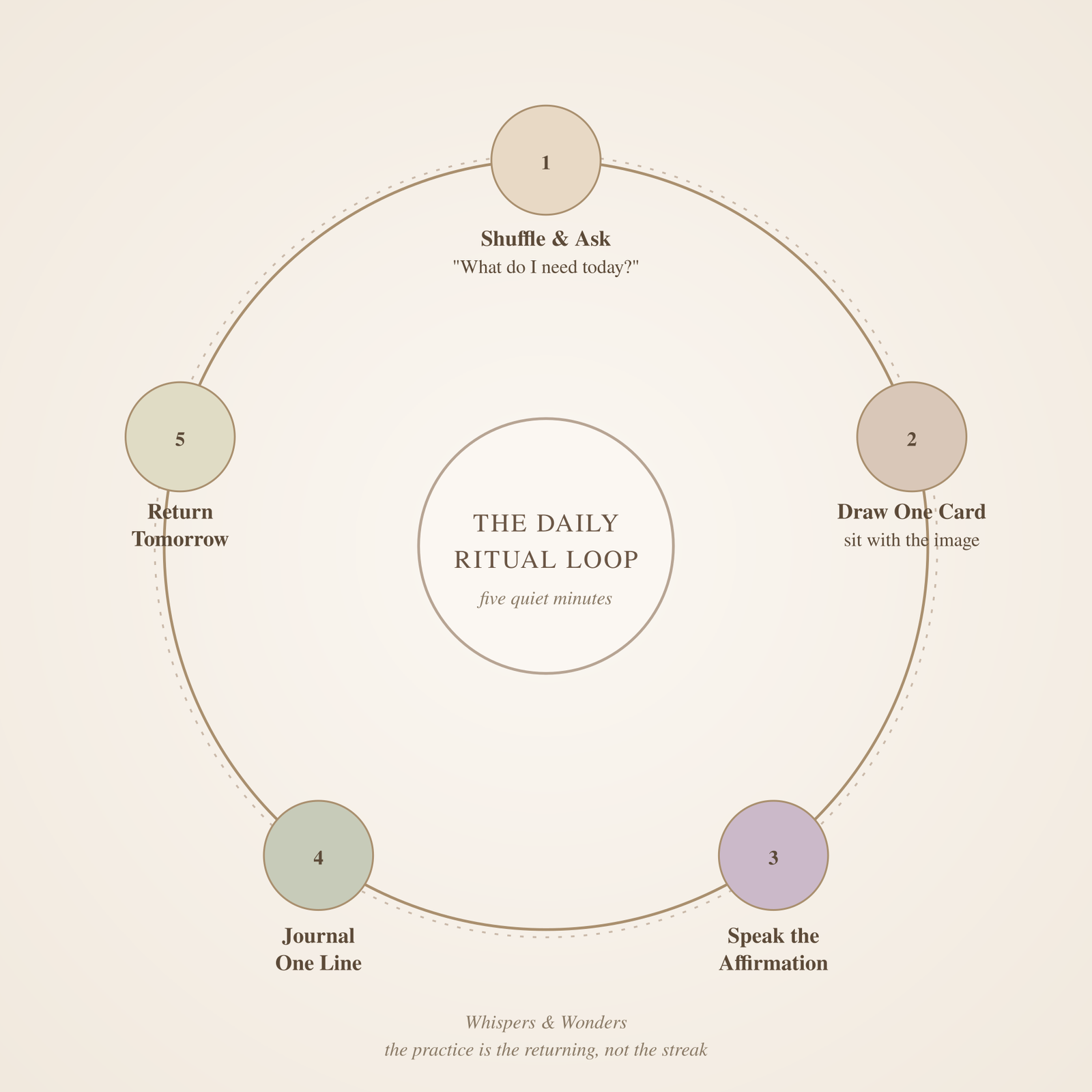
A single card is enough. Resist the urge to pull elaborate spreads every morning; that is a recipe for burnout. Ask an open question — "What do I most need today?" or "What energy am I bringing into this day?" — shuffle, and draw one card. Sit with the image before reaching for any meaning. Notice your first impression. Then read the card's message, speak its affirmation aloud, and consider its journal prompt. Speaking the affirmation matters more than it sounds: voicing an intention engages the body and makes the practice feel real. A Luck Lab Leather Tarot Holder gives the drawn card a dedicated resting place, elevating it from a quick glance to a small act of reverence.
Write It Down
A small journal transforms a daily pull into a record of your inner life. You need not write paragraphs. Note the date, the card, your one-line first impression, and — in the evening or the next morning — a single line about how the theme actually showed up. Over weeks and months, patterns emerge that no single reading could reveal: the cards that keep returning, the moods that follow certain pulls, the slow arc of a question working itself out. Your journal becomes both a personal dictionary of the cards and a mirror of your growth. A dedicated Tarot Journal by Peter Pauper Press gives you a beautiful, structured place to record each pull, and a Curawood Tarot Card Holder Stand keeps the day's card upright and visible on your desk as a quiet reminder all day long.

Add Sensory Anchors (Optional)
Once the core habit holds, you can enrich it. Light a candle to mark the start — a set of Baderke Colored Candles lets you choose a color that matches the day's intention. Burn a stick of Agarbatti Incense to purify the space and settle the mind. Hold a companion crystal chosen for the day's card. Brew a particular tea you reserve for this moment. These sensory cues are not required, but they deepen the sense of sacred pause and signal to your mind that something meaningful is beginning. The key word is optional — never let the trimmings become barriers to the practice itself.
A Second Voice for Reflection
Pair your morning pull with a single open-ended question of your own choosing — not about the card, but about your day ahead. A prompt like "What do I want to let go of today?" or "Where do I need patience?" gives you two angles on the same morning: what the card is showing you, and what you're bringing to it yourself. Many readers find that the interplay between a personal pull and a self-authored prompt sparks insights neither would produce alone.
When You Miss a Day
You will miss days. A trip, an illness, a stretch of chaos — the practice will lapse, and that is part of any practice, not a failure of yours. The danger is not the missed day; it is the story that one missed day means you "can't keep it up." When you notice the lapse, simply begin again at the next natural anchor. The cards are patient, and so is the garden. Treat the return as the practice rather than the streak.
Be Gentle With Yourself
Above all, hold this ritual lightly. Tarot is a tool for compassion, including compassion toward yourself. Some mornings the card will land like a revelation; other mornings it will feel like nothing at all, and both are fine. What matters is not perfection but the returning — the daily, ordinary act of pausing to ask yourself an honest question. Do that for a season and you will look back to find that five quiet minutes a day have quietly rearranged your relationship with your own life.
Troubleshooting a Stalled Practice
If your practice keeps stalling, the fix is almost always to make it smaller, not bigger. Drop from a spread back to a single card. Move the deck somewhere more visible. Lower the bar to "draw one card, even if I do nothing else." Motivation follows action far more often than it precedes it, so the goal is to make the first step almost effortless. If a particular time of day never works, experiment with another. The practice should bend to your life, not the other way around.
Another common stumbling block is over-interpretation — turning every pull into a high-stakes oracle. Let most days be ordinary. A daily card is a check-in, not a prophecy. Holding the practice lightly keeps it sustainable and keeps the cards in their proper role as gentle mirrors rather than anxious authorities.
The Long Arc of a Daily Practice
The rewards of a daily tarot ritual are cumulative and quiet. In the first weeks you simply learn the cards. After a few months you begin to notice your patterns reflected back to you. After a year, your journal becomes a remarkable record of a life examined — the questions you carried, the moods that moved through you, the slow resolution of things that once felt impossible. Few practices offer so much for so small a daily investment.
Evolving Your Ritual Over Time
A daily practice is not meant to stay frozen. As you grow more fluent with the cards, let the ritual evolve with you. You might graduate from single cards to a weekly three-card spread on Sunday evenings while keeping the daily pull simple. You might add a seasonal practice aligned with the moon, or begin reading for trusted friends. Some readers eventually develop their own spreads, their own card meanings, even their own small ceremonies. The point is to let the practice remain alive rather than rote — to keep listening for what it wants to become.
A Closing Blessing
In the end, a daily tarot ritual is a way of keeping a standing appointment with yourself. In a world that constantly pulls our attention outward, those few quiet minutes are an act of gentle rebellion — a daily turning inward to ask, honestly, how you are and what you need. However elaborate or simple your practice becomes, may it always serve that tender purpose.
One Card, Every Day
If you take only one idea from this guide, let it be this: the single daily card, drawn faithfully, is enough. It needs no special setting, no perfect mood, no elaborate spread. It asks only that you show up, draw, and pay attention for a few quiet minutes. Everything else — the journaling, the crystals, the candles, the moon — is optional enrichment layered on top of that simple, durable core. Protect the core, and the practice will carry you for years.
The garden is patient. Whenever you return to it, it is glad to see you.
Frequently Asked Questions
How long does it take for a daily tarot ritual to actually feel automatic?
Research on habit formation suggests it takes roughly two months on average, though it varies widely by person. The point isn't to rush that timeline — it's to keep the ritual small enough that you can show up on the days motivation is low.
Do I need a full spread every day, or is one card enough?
One card is enough, and often better. A single daily pull keeps the practice sustainable; save multi-card spreads for a weekly or occasional check-in so the daily version never starts to feel like a chore.
What if I miss a day, or several?
That's part of the practice, not a failure of it. Simply return at the next natural anchor — your next coffee, your next bedtime — rather than treating the lapse as proof you "can't keep it up."
Do I need candles, crystals, or a special setup to start?
No. Those are optional sensory enrichments you can add later. The only requirement is a deck, a question, and a few quiet minutes.
What's a good "why" if I'm not sure why I want a daily practice?
Start simple: self-awareness, calm, or creative momentum are all valid reasons. Your "why" doesn't need to be profound — it just needs to be honest enough to pull you back on the mornings you don't feel like it.
Shop This Post
This post contains Amazon affiliate links. As an Amazon Associate, Whispers & Wonders earns from qualifying purchases at no extra cost to you.
- Tarot Journal by Peter Pauper Press
- Luck Lab Leather Tarot Holder
- Baderke Colored Candles
- Curawood Tarot Card Holder Stand
- Agarbatti Incense
Continue Your Journey
- A Beginner's Guide to Reading Tarot
- Tarot and the Moon
- Crystals for Tarot
- The Spiritual Side of Tampa Bay
- Tarot Spread Library
> Ready to draw today's card? Draw Your Card →