The Journal
Home / Blog / How to Read Tarot When You're Too Close to the Situation
How to Read Tarot When You're Too Close to the Situation
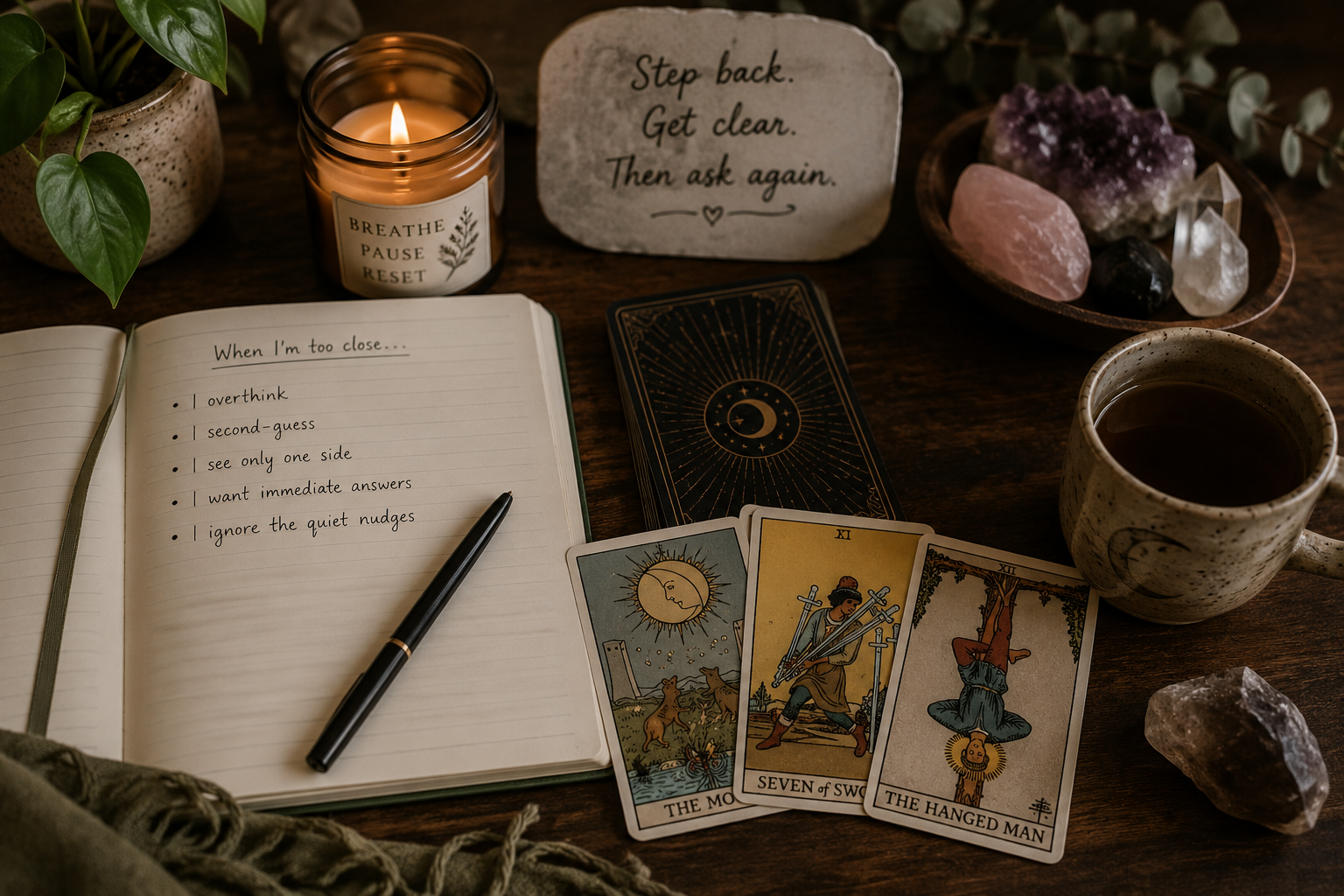
When you're emotionally invested in a tarot reading's outcome, objectivity becomes nearly impossible. Learn practical techniques for creating enough distance between yourself and the cards to actually hear what they're saying.
There's a specific kind of frustration that comes from shuffling your own deck, drawing a card, and immediately talking yourself into whatever meaning you were already hoping for. You wanted The Two of Cups to mean reconciliation, so that's what it means. You wanted The Tower to be about someone else's chaos, not your own. If you've ever caught yourself doing this, you're not bad at tarot — you're just human, and you're emotionally invested in the outcome.
At a Glance
- Read time: 6–8 minutes
- Best for: Readers who want honest, useful readings on situations they're personally tangled up in
- You'll need: Your regular deck, a journal, and about 15 quiet minutes
Why It's Harder to Read for Yourself in the Middle of Something
Tarot works best as a mirror, but mirrors are only useful when you can actually see clearly into them. When a reading touches something you're currently living through — a relationship on shaky ground, a job decision, a friendship that's gone quiet — your nervous system has a stake in the outcome. That's not a flaw in the practice. It's just what happens when the querent and the reader are the same anxious person.
Even experienced readers sometimes turn to someone else when they're too close to a situation.
Signs You're Too Close to Read Clearly
A few common tells that a reading needs more distance before you trust it:
- You reshuffle and redraw until you get a card you like better
- You're already forming the interpretation before you've fully looked at the card
- Every card somehow points to the same conclusion you walked in with
- You feel a jolt of anxiety or defensiveness at a specific card, rather than curiosity
- You're asking the same yes/no question in five different phrasings
None of these mean the reading is worthless. They mean it's time to slow down.
Techniques for Creating Distance
Reframe the question
Instead of "Does he still love me?" try "What do I need to understand about this relationship right now?" Process-oriented questions are harder to bend toward a hoped-for answer than yes/no ones, and they tend to produce more useful cards to sit with.
Read in third person
Ask about "the situation" or refer to yourself by name, as if you were describing someone else's circumstance. This small linguistic shift — a technique many readers use deliberately — creates just enough psychological space to notice a card's actual imagery instead of only its emotional charge.
Separate the draw from the interpretation
Pull your cards, write down exactly what you see — figures, colors, direction, symbols — before you let yourself assign meaning. Interpretation that happens too quickly is usually interpretation hijacked by hope or fear. Give the description a few minutes of head start.
Let the reading sit overnight
If a card lands hard, it's fine to close the journal and come back tomorrow. Readings about situations you're inside of often make more sense with twelve hours of distance than they do in the first five minutes.
Trade readings with someone else
If you know another tarot reader, trading readings on your respective tangled situations is one of the most reliable ways to get an honest read. A second set of eyes has no emotional investment in softening or sharpening what the cards say.
A Simple Outside Perspective Spread
When you want distance built into the structure itself, try this three-card layout:
1. Card One — What I can see clearly. The part of the situation you already understand.
2. Card Two — What my closeness is hiding from me. The blind spot proximity creates.
3. Card Three — What an outside observer would notice. The perspective you don't have access to alone.
This spread doesn't promise comfort. It's designed to surface what emotional closeness tends to obscure, which is often more useful than a reassuring answer.
A Crystal for Clarity
Amethyst pairs well with this kind of reading. It's traditionally associated with calming an overactive mind — useful when anxiety is doing more talking than intuition. Holding a piece while you shuffle, or simply keeping one near your reading space, can be a small physical cue to slow down before you interpret.
A Quiet Moment
Before you lay out a single card, try this: place your hand flat on the deck and ask yourself, out loud or in your journal, "What am I hoping this reading says?" Write the honest answer down. Then set it aside and begin. Naming the hope doesn't make it disappear, but it does make it easier to notice when it's steering the interpretation.
From My Own Practice
Tarot found me during a hard stretch in 2021, when I needed a way to sit with my own life instead of just reacting to it. What I learned early on is that the readings I trusted least were the ones I did in the middle of a spiral — half-hoping the cards would just tell me I was right. The readings that actually helped were the ones where I slowed down enough to ask what I might be missing, not just what I wanted to hear. That distinction has shaped how I read for myself ever since.
Frequently Asked Questions
Can I really read tarot for myself, or do I always need someone else?
You can absolutely read for yourself — most tarot practitioners do it regularly. The key is building in habits, like journaling before interpreting or using process-based questions, that create distance when a topic is emotionally loaded.
How do I know if a reading is objective or if I'm just seeing what I want to see?
A useful check is noticing your emotional reaction to each card. If you feel curiosity and a bit of surprise, you're likely reading openly. If every card conveniently confirms what you already believed, it's worth setting the reading aside and returning later.
Should I avoid reading about a situation I'm currently in the middle of?
Not necessarily — but treat those readings as a first pass rather than a final answer. Give yourself permission to revisit the same question later once emotions have settled.
What if the cards say something I don't want to hear?
That's often when a reading is most valuable. Uncomfortable cards aren't punishments; they're usually pointing at something worth looking at directly rather than around.
Is it better to use a specific spread for emotionally difficult questions?
Structured spreads, like the three-card Outside Perspective layout above, can help because they ask specific, separate questions rather than one big emotionally loaded one. That structure alone often produces more objective insight.
Continue the Journey
Continue exploring: A Beginner's Guide to Reading Tarot if you're just getting started.