The Journal
Home / Blog / Oracle Cards vs. Tarot: What’s the Difference (and Which Is Right for You)
Oracle Cards vs. Tarot: What’s the Difference (and Which Is Right for You)
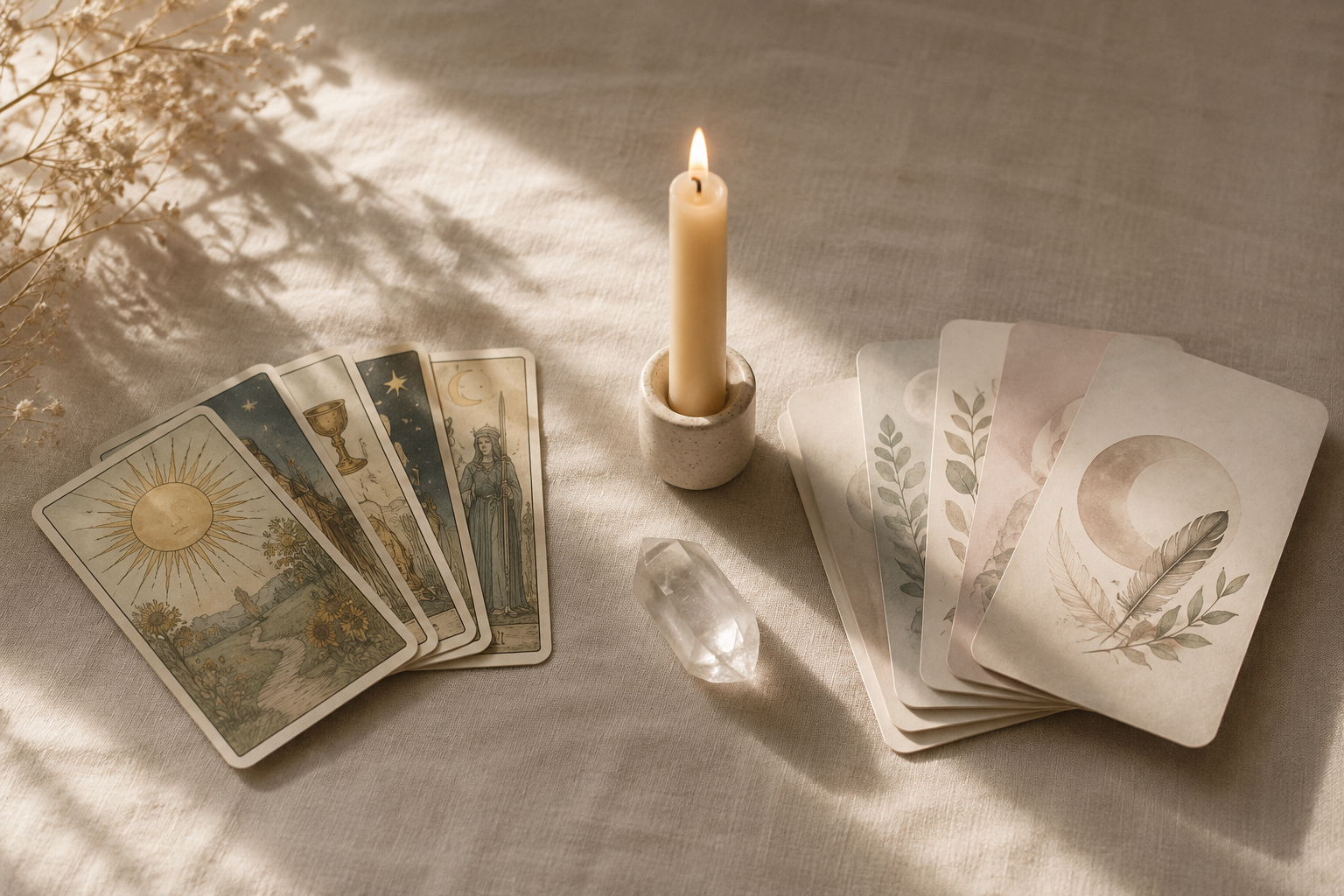
Oracle and tarot both offer reflection, but they work differently. Here’s how to choose the practice that fits your style.
Two Paths, One Purpose
When I first started exploring divination, I thought tarot and oracle cards were basically the same thing — just different decks with different pictures. It took a few months of reading to realize they’re actually quite different tools, each with its own rhythm and voice. Understanding those differences helped me choose which practice felt right for me, and it might help you do the same.
The Core Difference
The simplest way to think about it: tarot is a system, oracle is a language.
Tarot is a structured deck of 78 cards organized into the Major Arcana (22 cards) and Minor Arcana (56 cards divided into four suits). Each card has centuries of established meaning, and the structure itself teaches you something — the journey from The Fool to The World, the elemental logic of the suits, the numerology woven through the cards. When you learn tarot, you’re learning a language that has been spoken for centuries.
Oracle cards, by contrast, are more open-ended. An oracle deck might have anywhere from 30 to 60 cards, and there’s no standardized structure. Each deck is its own system, created by its author with its own themes, artwork, and guidebook. Oracle cards tend to be more direct and affirmation-focused, offering clear messages rather than layers of symbolism to unpack.
In Everyday Life
Tarot works beautifully for daily practice because the structure supports it. A single card drawn each morning becomes a meditation on one of 78 archetypal themes. Over weeks and months, you begin to recognize the cards as old friends, and the daily pull becomes a conversation with yourself. The Rider-Waite-Smith Tarot Deck is the classic starting point for this kind of practice.
Oracle cards shine when you want something gentler or more affirmation-focused. Many people use oracle cards for a quick morning message — draw one card and let its affirmation set the tone for the day. Because oracle decks are designed by individual creators, you can choose one that speaks to your particular interests: oracle cards for manifestation, for shadow work, for goddess wisdom, for animal guidance. A beginner-friendly oracle deck often feels more immediately accessible than tarot, especially if you’re drawn to a specific theme.
In Relationships
When you’re reading for someone else, the differences become even clearer.
Tarot offers a more complex reflection. If someone asks about a relationship question, a tarot reading can show you the dynamics at play, the obstacles, the potential outcomes. The structure of the cards gives you a vocabulary for nuance: this card suggests communication, this one suggests patience, this one suggests a boundary that needs setting. A tarot reading tends to be longer and more layered.
Oracle cards tend to offer more direct guidance. An oracle reading might say “Trust your intuition” or “This is a season of healing” — clear messages that feel more like advice than analysis. For someone seeking reassurance or a simple, direct answer, oracle cards often feel more satisfying.
In Personal Growth
Both tools support growth, but they approach it differently.
Tarot invites you to sit with complexity. The cards don’t always give you the answer you want; sometimes they show you a shadow side or an uncomfortable truth. That friction is where growth happens. Over time, a tarot practice becomes a way of developing emotional intelligence and self-awareness. You learn to hold multiple perspectives at once, to see situations from different angles, to trust your own interpretation over any guidebook.
Oracle cards tend to support growth through affirmation and encouragement. They remind you of your own wisdom, your resilience, your capacity for change. If you’re in a vulnerable place or just beginning a spiritual practice, oracle cards can feel like a supportive friend whispering “You’ve got this” at exactly the right moment.
Spiritual Reflection
Tarot connects you to a long tradition. When you pull The Hermit or The Lovers, you’re engaging with cards that have been contemplated for centuries. That historical depth can feel grounding and meaningful. Many people find that working with tarot deepens their sense of connection to something larger than themselves.
Oracle cards connect you to the creator’s vision. Each oracle deck is a unique expression of one person’s or one group’s spiritual perspective. Working with oracle cards is a way of entering into dialogue with that creator’s wisdom. If you find a deck whose artwork and messages deeply resonate with you, that resonance becomes part of your practice.
Crystal Pairing: Clear Quartz
Both tarot and oracle readings benefit from a companion crystal. Clear Quartz is the universal amplifier — it enhances clarity and intention regardless of which cards you’re working with. Hold a Clear Quartz Crystal Point while shuffling, or place it near your spread to sharpen your intuition and focus your attention on the message the cards are offering.
A Quiet Moment
The real difference between tarot and oracle isn’t about which is “better” — it’s about which matches your temperament and your needs in this season. Some readers use both: tarot for deep work and daily practice, oracle for quick morning messages or when they want something lighter. Others commit to one and find it sustains them for years. There’s no wrong choice, only the choice that feels true to you.
Continue the Journey
If you’re drawn to tarot, start with A Beginner’s Guide to Reading Tarot and explore our full Cards library. If oracle cards call to you, choose a deck that speaks to your heart and begin with a simple daily pull. And if you want to explore both, you might try tarot for a weekly deeper reading and oracle for a daily quick message. The practice that sustains you is the one that’s right for you.
Frequently Asked Questions
Can I use oracle and tarot cards together in the same reading?
Yes, many readers do. Some people use tarot as the foundation and add an oracle card for clarification or affirmation. Others alternate between the two depending on the question. There’s no rule against mixing them — experiment and see what feels right.
Which is easier to learn, tarot or oracle?
Oracle cards are generally considered easier to learn because there’s no standardized system to memorize. Each deck comes with its own guidebook, and the messages tend to be more straightforward. Tarot has more structure and symbolism to learn, but that structure is also what makes it so rich and rewarding over time.
Do I need to be spiritual to use either one?
No. Both tarot and oracle cards work as tools for reflection and self-awareness, regardless of your spiritual beliefs. Many people use them simply as a way to slow down and ask themselves honest questions.
Can I read oracle or tarot cards for myself, or do I need someone else to read for me?
You can absolutely read for yourself. In fact, most daily practice is self-reading. Some people find that reading for themselves feels more intimate and honest than having someone else read for them.
What if I want to try both before committing to one?
That’s a great approach. Start with a beginner-friendly oracle deck and the Rider-Waite-Smith Tarot Deck, and spend a few weeks with each. Notice which one you reach for more often, which messages feel more resonant, which practice you actually keep up with. Your own experience will tell you which is right for you.
Shop This Post
This post contains Amazon affiliate links. As an Amazon Associate, Whispers & Wonders earns from qualifying purchases at no extra cost to you.
- Clear Quartz Crystal Point
- Beginner-Friendly Oracle Deck
- Rider-Waite Tarot Deck
- Reading Journal for Tarot & Oracle Pulls
Continue Your Journey
- A Beginner’s Guide to Reading Tarot
- Tarot and the Moon
- Crystals for Tarot
- Building a Daily Tarot Ritual That Lasts
- The Spiritual Side of Tampa Bay
> Ready to explore the cards? Browse Our Full Cards Library →