The Journal
Home / Blog / What to Do When a Tarot Reading Makes Absolutely No Sense
What to Do When a Tarot Reading Makes Absolutely No Sense
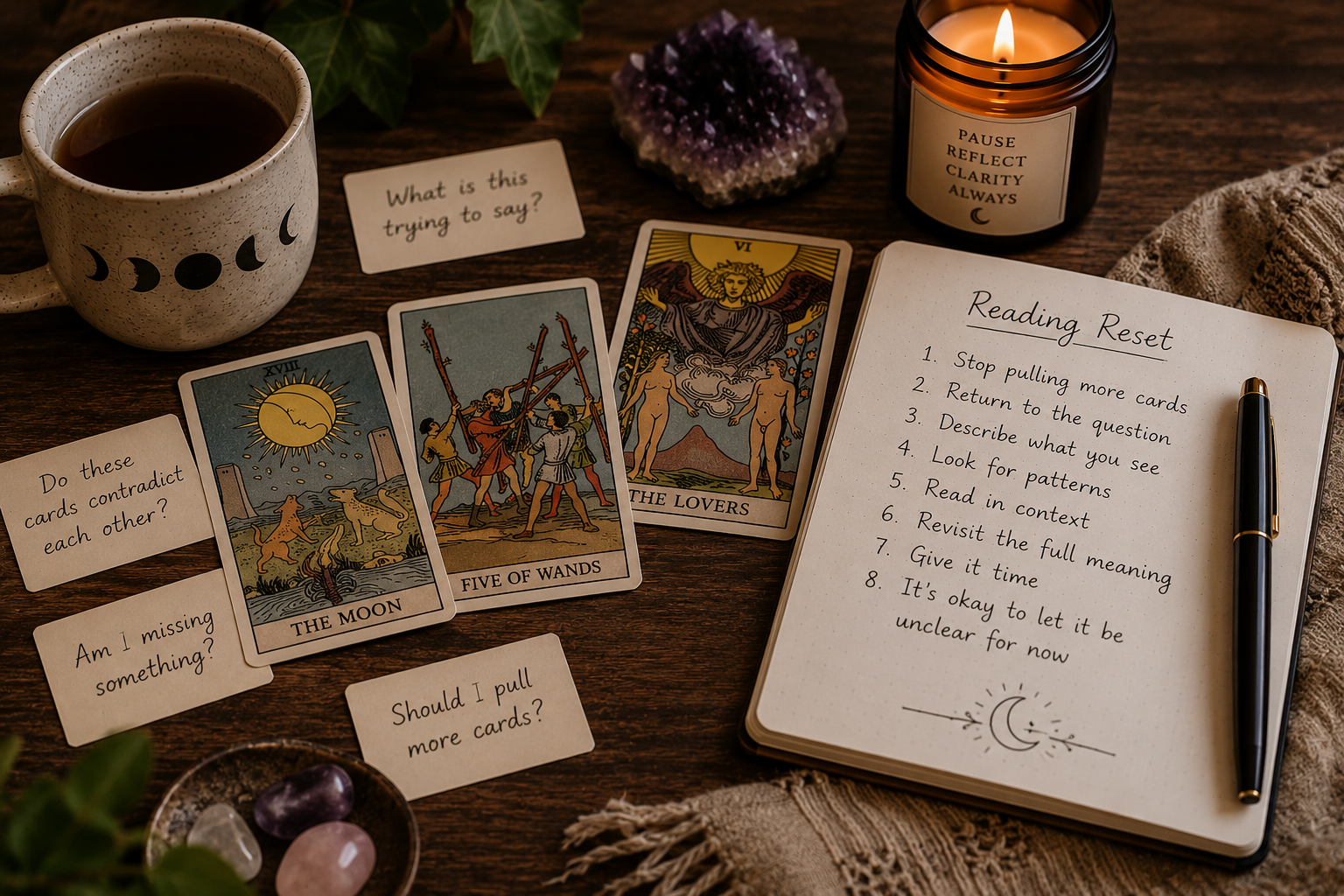
When a tarot reading leaves you confused—cards that seem to contradict, keywords that don't connect, or clarity that simply won't arrive—it's not a failure. Learn practical troubleshooting steps to understand what went wrong and when it's okay to simply set the reading aside.
You laid out the cards. You looked at them. And nothing clicked. Maybe the cards seem to be arguing with each other. Maybe you can name every keyword and still have no idea what the reading is actually saying. Maybe you're just staring at three or five or seven pieces of cardstock, waiting for a feeling of clarity that isn't arriving.
At a Glance
- What this covers: Why readings sometimes feel confusing or contradictory, and what to actually do about it
- Core idea: Confusion usually points to something fixable — the question, the card count, or how the cards are being read — not a broken reading
- What you'll get: A step-by-step troubleshooting process and a short reset exercise for when you're stuck
- What this isn't: A guide to forcing meaning out of a reading that genuinely isn't ready to make sense yet
Why Readings Get Confusing
The question was too broad or unclear
"What does the universe want for me?" is nearly impossible for any spread to answer well, because the cards have nothing specific to respond to. Broad questions tend to produce broad, scattered-feeling answers — not because the cards failed, but because the question didn't give them anywhere to land. A tighter question, even a modest one like "What should I focus on with this project this week?", almost always produces a more legible reading than an enormous, open-ended one.
Too many cards were pulled
It's tempting, when a reading feels unclear, to add more cards to "get more information." In practice, this often makes things worse. A ten-card spread asks you to hold ten separate pieces of symbolism in relationship to each other, which is a real cognitive load even for experienced readers. If a three-card pull already feels muddy, adding four more cards rarely clarifies it — it usually just adds more noise to sort through.
Leaning too hard on memorized keywords
Keywords are a starting point, not the whole language. If you're mentally translating each card into a single word — "Death: change," "The Star: hope" — and then trying to stack those words into a sentence, you'll often end up with something that technically parses but doesn't actually mean anything specific to your situation. Tarot imagery carries more nuance than any keyword list can hold, and leaning on it too heavily is one of the most common reasons a reading feels flat or contradictory.
The cards seem to contradict each other
Sometimes two cards do seem to be pulling in opposite directions — one suggesting caution, another suggesting action. This isn't necessarily a malfunction. Real situations are often genuinely mixed: a choice can be both promising and risky at the same time. A reading that reflects that complexity accurately is doing its job, even if it doesn't hand you a tidy, single-direction answer.
Trying to force a prediction from cards built for reflection
Tarot is often more useful for exploring a situation than for forecasting exactly what will happen. If you're asking a reflective question ("What do I need to understand about this?") but interpreting the cards as if they owe you a specific prediction, the mismatch itself can create confusion. The cards aren't failing to predict — the question and the interpretation style aren't lined up with each other.
Emotional investment is clouding the read
When you deeply want (or deeply fear) a particular outcome, it's hard to read the cards neutrally. You might find yourself unable to settle on any interpretation because part of you is rejecting the ones that don't match what you're hoping for. This isn't a flaw in your reading skill — it's just what happens when the person asking the question and the person interpreting the answer are the same anxious person. (If this feels familiar, How to Read Tarot When You're Too Close to the Situation covers this specific challenge in more depth.)
The situation itself is still unclear
Sometimes a reading is muddled because the actual circumstance you're asking about hasn't resolved into something clear yet. If you genuinely don't know what you want, or the situation is still developing, it's reasonable for the reading to reflect that same uncertainty back at you. The cards can't manufacture clarity that doesn't exist yet in the underlying situation.
Sometimes it just doesn't come together — and that's fine
Occasionally, none of the above apply and the reading simply doesn't cohere. This is a normal, unremarkable part of tarot practice. You're allowed to set it down, without needing to manufacture an interpretation just to feel like the time wasn't wasted.
A Step-by-Step Process for a Confusing Reading
When a reading isn't landing, work through this instead of reshuffling:
1. Stop pulling additional cards. More cards rarely solve confusion — they usually compound it. Pause before adding anything to the spread.
2. Return to the original question. Say it out loud or write it down exactly as you asked it. Is it specific enough to actually be answerable? If not, that alone may explain the confusion.
3. Describe what's literally visible before interpreting. For each card, write down what's physically in the image — figures, objects, colors, direction of movement — before assigning meaning. This slows down the jump to interpretation and often reveals details you'd otherwise skip past.
4. Look for relationships across the cards. Are multiple cards from the same suit? Do the numbers climb or repeat? Are figures facing toward or away from each other? Patterns across a spread are often more informative than any single card read alone.
5. Read each card in its position, not in isolation. A card in a "past" position and the same card in an "advice" position are doing different jobs. Confusion often comes from reading all the cards as if they're answering the same question, rather than the specific question their position is asking.
6. Revisit the full meaning of unfamiliar cards. If a card feels vague to you, it may be because you only remember its keyword rather than its fuller meaning. Looking up its complete upright and reversed meanings — in the Whispers & Wonders tarot card library or another full reference — can restore nuance a keyword alone doesn't carry.
7. Write the reading down and come back later. Some readings need time, not more effort in the moment. Recording the cards, positions, and your initial impressions lets you return with fresh eyes tomorrow, or next week, without needing to solve it on the spot.
8. Give yourself permission to let it go. Not every reading resolves into a clear answer, and that's an acceptable outcome. Concluding "this isn't clarifying anything right now" is a legitimate stopping point, not a failure.
The Reading Reset Exercise
When you're stuck mid-reading and want a quick way to recalibrate, try this:
- Pause. Set the cards down without pulling more. Take one slow breath before doing anything else.
- Restate the question in one plain sentence. No mysticism, no elaborate phrasing — just what you actually want to know.
- Pick the one card pulling your attention most. Not the "correct" one, just the one your eye keeps returning to. Describe only what you see in it.
- Ask one grounding question: Does this card's description match anything true about my situation right now? If yes, start there. If no, it's fine to acknowledge the reading isn't clicking today.
- Decide: continue, or close it out. Either work through the rest of the spread using this slower, description-first approach, or set the whole reading aside with permission to revisit it later.
This isn't about forcing the reading to make sense. It's about giving yourself a structured way to tell whether it's ready to.
A Quiet Moment
Before you decide a reading has "failed," ask yourself honestly: is the confusion coming from the cards, or from how much I want a specific answer right now? Sometimes naming that is enough to loosen the tangle. Sometimes it isn't — and that's fine too.
Frequently Asked Questions
Does a confusing reading mean I did something wrong?
Not usually. Confusing readings are often the result of a question that was too broad, a spread that was too large, or an interpretation style that doesn't match what the question was actually asking — not a mistake in how you shuffled or drew.
Should I keep pulling clarifying cards until it makes sense?
It's generally better not to. Adding more cards tends to add more complexity rather than resolve it. If a reading isn't clarifying, stepping back and revisiting your original question is usually more useful than expanding the spread.
What if the cards genuinely seem to contradict each other?
That's not automatically a problem. Situations are often mixed, and a reading that reflects real complexity — caution alongside opportunity, for example — can be accurate even when it isn't tidy.
Is it okay to just stop and walk away from a reading?
Yes. Not every reading needs to resolve into a clean answer in the moment. Setting a confusing reading aside and returning to it later — or simply letting it go — is a normal part of tarot practice.
How do I know if I'm reading too literally into keywords?
If your interpretation feels like a string of disconnected words rather than something that actually speaks to your situation, that's often a sign it's worth slowing down and looking at the full card imagery and meaning again, rather than relying on a one-word shorthand.
Continue the Journey
Continue exploring: How to Read Tarot When You're Too Close to the Situation, or A Beginner's Guide to Reading Tarot if you're still building your foundational reading practice.