The Journal
Home / Blog / Why the Same Tarot Card Keeps Appearing in Your Readings
Why the Same Tarot Card Keeps Appearing in Your Readings
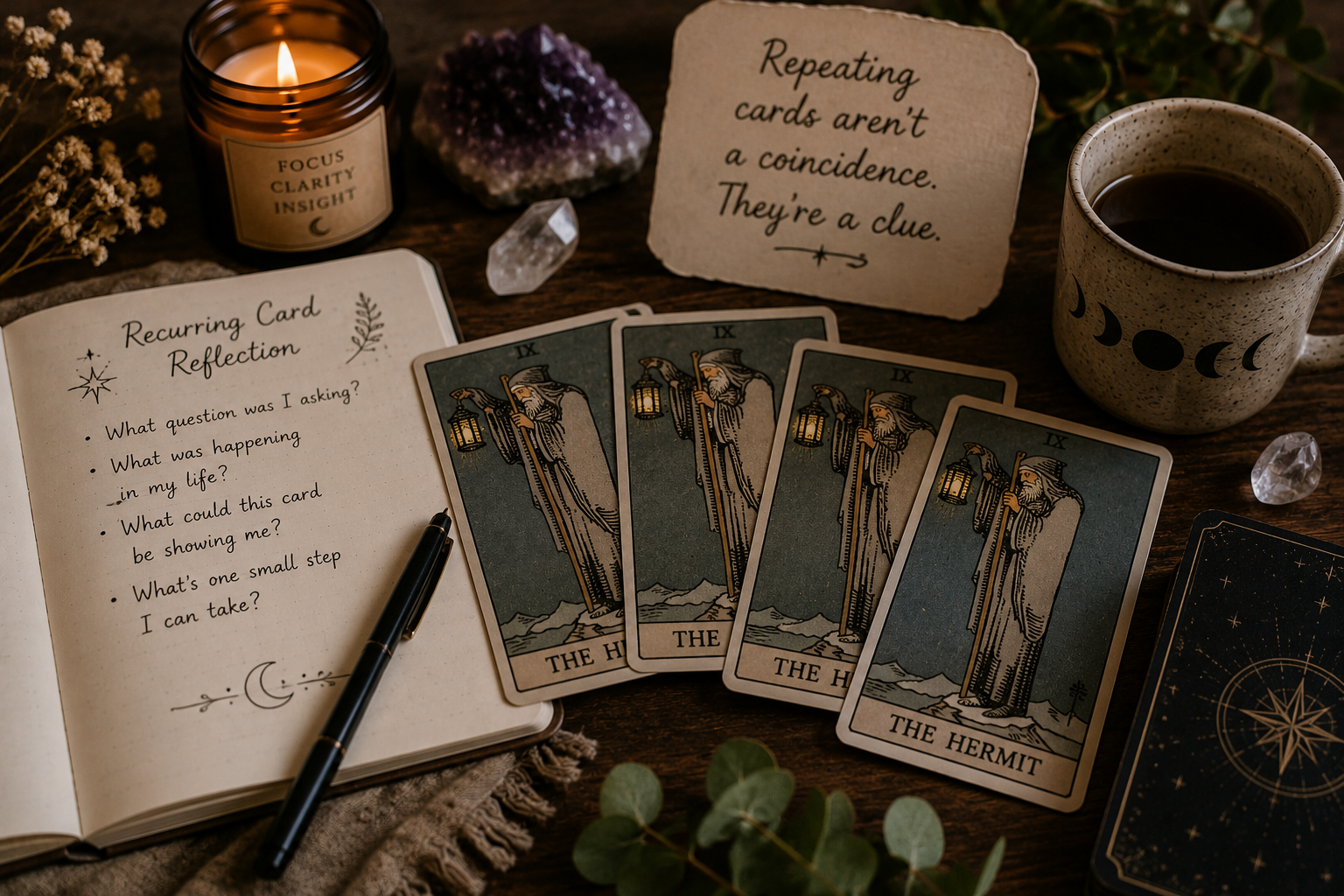
When the same tarot card keeps appearing in your readings, it's easy to assume something mystical is happening. Learn the practical and psychological reasons cards repeat—and how to tell the difference between meaningful patterns and statistical chance.
You shuffle. You pull. And there it is again — the same card that showed up last week, or three readings ago, or every single time you've asked about this one particular thing. Maybe it's a card you love and you've stopped trusting the good feeling. Maybe it's one that unsettles you a little more each time. Either way, the question that follows is almost always the same: why does this keep happening?
At a Glance
- What this covers: The practical and psychological reasons a card repeats, not a single mystical explanation
- Best for: Readers who've noticed a pattern and want to understand it rather than just feel unsettled by it
- What to do about it: Journal the context around each pull, then look for what's actually consistent
- The short version: Sometimes it's meaningful, sometimes it's math, and journaling is how you tell the difference
The Deck Is Smaller Than It Feels
Start with the least dramatic explanation, because it's often the most overlooked: a standard tarot deck has 78 cards, and depending on your spread size, the odds of a repeat aren't as rare as they feel in the moment. If you're pulling single cards frequently — daily draws, quick check-ins — the math is simply on the side of repetition happening more often than pure intuition would suggest.
This isn't meant to deflate the experience. It's meant to give you a baseline. Before reaching for a bigger explanation, it's worth asking: how often am I actually pulling cards, and does the frequency of this repeat fall within what chance alone would produce? If you're drawing daily and a card shows up twice in three weeks, that's very different from a card appearing four readings in a row.
You Might Be Asking the Same Question in Different Clothes
One of the most common reasons a card repeats has nothing to do with the deck and everything to do with the querent. If you're circling back to the same relationship, the same job decision, or the same unresolved worry — even when you phrase the question differently each time — you're essentially asking the deck to respond to a situation that hasn't changed. A consistent situation can reasonably produce a consistent card, especially in decks where a small number of cards genuinely do speak to the specific dynamic you're navigating.
It's worth being honest with yourself here. "Should I text him back?" and "What do I need to know about this relationship?" and "What's coming for us?" can all be the same underlying question wearing different words. If that's happening, the repetition might be less mysterious and more like asking the same question of anyone — you'd expect a similar answer.
Interpretation Habits and Confirmation Bias
Readers develop favorite lenses over time, often without noticing. If you've decided a particular card means something specific to you — say, The Tower always signals an ending — you may start unconsciously steering your questions, your shuffles, or even your attention toward drawing it, especially during a period where endings are already on your mind. This isn't a criticism; it's just how attention works. We notice what we're primed to notice, and we remember the hits more than the misses.
This is also where it helps to ask: am I actually pulling this card more than usual, or am I just noticing it more than usual because it caught my attention the first time? Those are different phenomena, and only journaling reliably tells them apart.
An Unresolved Theme Worth Sitting With
Sometimes a card repeats around a theme that genuinely hasn't been resolved, even if the specific question has changed. You might ask about work, then about a friendship, then about your own habits — and the same card shows up because an underlying pattern (avoidance, self-doubt, a boundary you haven't set) is threading through all three areas of your life. In this case, the repetition isn't about one static situation; it's about a theme still active enough to surface across different contexts.
This is where tarot can be genuinely useful as a reflective tool — not because the card is insisting on anything, but because its recurrence gives you a reason to ask what connects these separate questions.
Sometimes Circumstances Just Haven't Changed
This one is simple and easy to overlook: if nothing about your situation has shifted, there's no particular reason the reading should shift either. A card reflecting stagnation, waiting, or an unresolved choice can reasonably keep appearing for as long as you're genuinely still in that holding pattern. In these cases, the repeated card isn't predicting anything — it's describing something that's still true.
Some Readers Interpret It Spiritually — and That's a Valid Lens, Framed Honestly
Many tarot readers experience recurring cards as meaningful in a more intuitive or spiritual sense — a sign worth paying attention to, a nudge toward something they haven't fully faced. That's a real and common way people relate to their practice, and if it resonates with you, there's nothing wrong with holding it. But it's worth naming clearly as an interpretation rather than a fact: tarot doesn't have a verified mechanism for delivering messages, and treating a repeated card as proof of a predetermined lesson can sometimes do more to keep you stuck in an explanation than to actually help you move through whatever the card is reflecting. The more useful question is usually not "what is this card trying to tell me" but "what do I notice when I sit with this card again."
What to Actually Do When a Card Keeps Showing Up
1. Track it before you interpret it. Write down the date, your question, and the card — every time it appears. Patterns are much easier to see on paper than in memory, which tends to smooth things over or exaggerate them.
2. Look at your questions side by side. Read back through what you were actually asking each time the card appeared. Are they genuinely different questions, or variations on one unresolved thing?
3. Check the frequency against your practice. If you're pulling cards daily, a repeat within a few weeks may simply be statistically unremarkable. If you rarely pull cards and the same one shows up twice in a row, that's a smaller, more notable pattern worth sitting with.
4. Read the card's full meaning again, slowly. It's easy to flatten a card into a single keyword over time. Revisit its complete meaning — upright and reversed, the traditional symbolism, the way different situations shift its tone — in the Whispers & Wonders tarot card library, rather than relying on the shorthand you've built up in your head.
5. Ask what's still unresolved, not what's being predicted. Shift the framing from "what does this mean is going to happen" to "what part of this is still asking for my attention."
A Repeated Card Reflection Exercise
When a card shows up again, try this short structure instead of jumping straight to interpretation:
- Name it plainly. Which card, and how many times have you noticed it in the last month?
- Recall the context. What was actually happening in your life each time it appeared? Write a single honest sentence for each occurrence.
- Look for the thread. Is there a question, feeling, or circumstance that shows up in more than one of those sentences?
- Separate fact from feeling. What has genuinely stayed the same in your life, versus what feeling this card brings up in you regardless of circumstance?
- Decide on one small action. Not a grand resolution — just one concrete, honest step that responds to what you noticed, even if that step is simply continuing to watch for the pattern a while longer.
This exercise won't tell you definitively why the card is repeating. What it will do is give you real information to work with, instead of a vague sense that something is happening beneath the surface.
A Quiet Moment
Before your next reading, take a breath and ask yourself honestly: is there a question I keep bringing to the cards without quite asking it out loud? You don't need an answer right away. Just notice whether one exists.
Frequently Asked Questions
Does a repeating tarot card mean something is definitely trying to reach me?
Not necessarily. Repetition can come from genuine chance, from asking related questions in different words, from noticing patterns more once you've spotted them once, or from a theme in your life that hasn't resolved. It's worth exploring rather than assuming any single cause.
How many times does a card need to repeat before it's worth paying attention to?
There's no fixed number. What matters more is the ratio — how often you're pulling cards overall versus how often this specific one shows up — and whether journaling reveals a real thread connecting the occurrences.
Should I stop asking about a topic if the same card keeps coming up?
Not necessarily, but it may be worth changing how you're asking. If your questions are actually the same question repeated in different phrasing, a repeated card is a fairly expected outcome, not a sign to stop.
Is it bad if the card that keeps appearing feels unsettling?
No. A card that feels difficult often just points to something you haven't fully sat with yet, not a warning. Its repetition is more useful as an invitation to look closer than as something to fear.
Can journaling really tell me if a pattern is meaningful or just chance?
Journaling won't give you certainty, but it gives you something more useful than guessing — an honest record you can look back on to see whether the repetition tracks with real, consistent circumstances or whether it's scattered across genuinely unrelated moments.
Continue the Journey
Continue exploring: How to Read Tarot When You're Too Close to the Situation, or A Beginner's Guide to Reading Tarot if you're building your foundational practice.